Physico-Mechnical Properties and Development of a Prototype Machine for Simultaneous Peeling, Slicing and Decoring of Tender Jackfruit
Physico-Mechnical Properties and Development of a Prototype Machine for Simultaneous Peeling, Slicing and Decoring of Tender Jackfruit
Minati Mohapatra*1, Dhanusa KV1, Jyoti Soren1, US Pal1, RR Pattnaik2
1Department of Agricultural Processing and Food Engineering, College of Agricultural Engineering and Technology, Odisha University of Agriculture and Technology, Bhubaneswar, Odisha, INDIA– 751003
*Corresponding author: Minati Mohapatra, Department of Agricultural Processing and Food Engineering, College of Agricultural Engineering and Technology, Odisha University of Agriculture and Technology, Bhubaneswar, Odisha, INDIA– 751003. Phone: +919439580445, ORCID: 0000-0001-9814-9783. Email: minati.agfe@gmail.com, minatim.apfe@ouat.ac.in
Citation: Mohapatra M, Dhanusa KV, Soren J, US Pal, RR Pattnaik (2025) Physico-Mechnical Properties and Development of a Prototype Machine for Simultaneous Peeling, Slicing and Decoring of Tender Jackfruit. Adv in Nutri and Food Sci: ANAFS-257.
DOI: 10.37722/ANAFS.2025204
Abstract
Processing of tender jackfruit involves peeling, decoring, slicing and cutting into pieces, which are the most important unit operations, but, very tedious due to its hard-spiked outer layer and gums present within. Peeling, decoring, slicing and dicing of tender jackfruit is done manually with knives and there is no systematic equipment is commercially available. Therefore, development of a prototype jackfruit cutting machine is utmost required with involving peeling, slicing and decoring in a single pass. A prototype machine has been developed for peeling, decoring and slicing of tender jackfruit considering all its physico-mechanical properties. Tender jackfruit at three maturity levels (30, 60, 90 days after flowering) were studied for determination of physico-mechanical properties. Performance of the machine was evaluated at three different sizes of cutting blade (75, 85, 105 mm diameter) and evaluated in terms of peeling efficiency, decoring efficiency, peel loss, vegetative loss and quality performance efficiency. Physical properties of tender jackfruit e.g., weight, length, diameter, core diameter, thickness of peel and theoretical peel content varied from 1238.52±135.67g to 2383.34±292.38g, 22 – 27.22 cm, 9.97- 12.88cm, 3.32-3.94cm, 4.2-7.4 mm, 42.33 to 55.33% respectively. Hardness of vegetative part and peel, maximum resistance force of three categories of jackfruits were ranged from 22.1to 26.3N, 18.4 to 38.3N, 638.25 to 1150 N respectively. Peeling efficiency, quality performance efficiency, coring efficiency and vegetable loss varied from 87.32 to 91.76 %,83.95 to 92.42 %,82.84 to 88.61%, 7.5 to 16.33 % respectively. The developed jackfruit machine was optimum to be operated at 7.5 cm coring blade size with fruit weight of 1.0 to 1.5 kg for maximum quality performance efficiency of 92.42%, peeling efficiency of 89.32% and less vegetative loss of 7.5% w/w.
Keywords: Decoring, Jackfruit, Peeling efficiency, Peeling, Physical properties
Introduction
Jackfruit (Artocarpus heterophyllus L.) is grown tropically as an evergreen tree,has the largest edible fruit. Jackfruit is consumed not only as a fruit when ripe but also as vegetable in the unripe or tender stage. Tender jackfruit is rich in vitamin B, C, potassium, calcium, iron, proteins and high level of carbohydrates. It is also rich in dietary fibre, which makes it a good bulk laxative. Fresh ripe jackfruit has small amounts of vitamin-A, and flavonoid pigments such as carotene-ß, xanthin, lutein and cryptoxanthin-ß.
Processing of tender jackfruit involves, minimally processed cut jackfruit pieces, modified atmosphere packaging and canned product etc. Peeling is the most important unit operation for tender jackfruit processing. But, it is a very tedious job due to presence of hard-spiked outer layer and gums present within it. In manual peeling, by knife or sharp blade, it takes more time for peeling and incurs a substantial amount of vegetative losses. Mechanical, thermal and chemical peelings are conventional methods used for peeling of different fruits and vegetables (Barreiro et al., 2007;Bahnasawy et al., 2004; Brown et.al., 1970; Caceres et. al., 2012; Wangyang. 2013). These methods apply mechanical tools, heat or cold, lye, freezing and irradiation etc.Adetan et al. (2006) used a peeling machine for peeling of root slices of 100 mm length based on the principle of peel-flesh separation through compression and peel removal with knives. Siti and Shima, (2010) designed a small sized and light weight machine to combine the grating and peeling processes in one device. Singh and Shukla (1995) developed a power operated batch type mechanical peeler for potato of capacity 100Kg/h with a peeling efficiency and peel losses of 78.0% and 6.0% respectively
For commercial processing of tender jackfruits e.g. for canning or further value addition, so far,there is no systematic machine available for peeling. Development of a peeling machine will not only separate the inedible parts from vegetables (like peel and core), but also befree from drudgery, faster in operation and environment friendly. The knowledge of physical and mechanical properties is essential for development of machine for primary processing i.e. peeling, cutting, slicing, dicing etc. Physical properties of the vegetables such as moisture content, size, shape, volume, surface area, density and amount of peel per unit weight of vegetable are affected with the stages of maturity and varies with body weight. Several studies have been reported about differences in physical and mechanical properties of Artocarpus fruit and size wise variation in biochemical composition (Thakur &Vidyasagaran, 2014; Rana et al., 2018) and mechanical properties of Egyptian onion cultivar (Bahnasawy et al., 2004), however, they have not been utilized for peeling studies of the products. Knowledge of the physical and mechanical properties are necessary to design and develop a semi-mechanized tool to cut jackfruit and to separate peel and core from the fruit. The objective of the present study is to determine the physico-mechanical properties of tender jackfruit at different maturity level and to develop a prototype machine for peeling, decoring and slicing of tender jackfruit at one stretch.
Materials and Methods
Collection of vegetables
Tender jackfruit (var: khaja) were plucked from identified trees of the campus, Odisha University of Agriculture and technology, used for the determination of physical and mechanical properties. Damaged free fresh vegetables werewashed with clean water to remove dirt on their surface and allowed to dry. Tender jackfruits were plucked at three stages of maturity i.e. after 30, 60 and 90 days of flowering initiation. Tender jackfruit, weight range was selected between 500g to 3500 g. Below this range, tender jackfruits are very small with less amount of edible part which were not fit for consumption. Up to 3,500 grams the fiber content in the jackfruit was not fully developed and the vegetables were in tender stage. Beyond 3,500 grams there would be fiber development and increase in size of seeds which was not desirable for use as vegetable.Different Physical properties of the vegetable such as moisture content, size, shape (sphericity), surface area and amount of peel per unit weight of vegetable were determined.
Moisture Content (MC)
Moisture content of vegetables was determined by hot air oven drying method as described by ASAE (1998). To know the difference in moisture contents of peel and vegetative part, their moisture contents were calculated separately.
Moisture content of vegetables was determined by hot air oven drying method as described by ASAE (1998). To know the difference in moisture contents of peel and vegetative part, their moisture contents were calculated separately.
Size
Vegetable Length (l) and equivalent diameter(d)were measured at different portions e.g. top, middle and bottom, for accurate measurement. The final dimensions were calculated by taking average of dimensions in three portions. These dimensions were measured by using Vernier caliper and outside caliper. The Vernier caliper was used to measure the length of the vegetables and outside caliper was used to measure dimeter in three orthogonal directions at different locations.
Sphericity
Sphericity of tender jackfruit vegetables was found out by using the following formula(eq.1).:

where, l = length of vegetable
d = equivalent diameter of the vegetable
Surface area
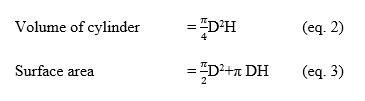
Surface area and volume were measured using the water displacement method and assuming cylindrical shape of tender jackfruit, volume and surface areas were mentioned in below equations.
Volume of cylinder = D2H (eq. 2)
Surface area = D2+π DH (eq. 3)
Here, D = Diameter of the cylinder, cm
H = Height of the cylinder, cm
Theoretical peel content
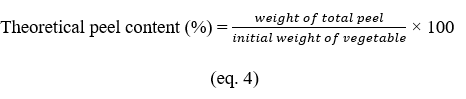
Peel content of jackfruit was found out by manually peeling the vegetable with a hand peeler or knife. The weight of unpeeled vegetable, peeled vegetable and the peel removed were measured using the digital weighing balance. Theoretical peel content of vegetable was calculated with following formula (eq 4). Vegetable to peel ratio was calculated as the ratio of proportion of weight of vegetative part to peel weight of the peeled jackfruit
Mechanical properties
Mechanical properties were found with the help of texture analyzer (Model: TA. XT plus, Make: Stable Micro System, Surrey, United Kingdom). Mechanical properties of vegetables were determined at three different locations like top, middle and bottom by taking cutting pieces from these portions. Cutting and shearing tests were conducted with cutting blade with the following test conditions: Pre-test speed – 2.00mm/s, Test speed – 2.00mm/s, Post-test speed – 10.00 mm/s, and Distance – 30.00mm. Hardness test was conducted with 2mm probe with the following test conditions: Pre-test speed – 2.00mm/s, Test speed – 2.00mm/s, Post-test speed – 10.00mm/s and Distance – 15.00mm.
Development of prototype for peeling-slicing-decoring of tender jackfruit
A prototype machine with manual hand operating system has been developed for (Figure 1) peeling, coring and slicing of tender jackfruit. Machine components and their dimensions were determined according to the convenience and the properties measured for the jackfruit. It consists of a cutting and coring unit, lead screw, handle to rotate the lead screw and the cutting blade,

1. Handle , 2. Lead screw, 3. Cutting blade, 4. Adjusting guide, 5. Adjustable fruit holding jaws, 6. Vegetable holding plate, 7. Base frame
Performance evaluations were conducted for tender jackfruit cutting using the prototype machine. First of all, both the end of the vegetable were made flat by removing some amount of the vegetative part. Then it was fixed to the machine with the help of holding jaws and plate. Then the machine was operated with handle and rotated constantly to peel, decore and slice the jackfruit. After completion of the process, vegetable was unmounted weighed. Similarly, peel and core removed with the machine were collected and weighed. By using these weight values peeling efficiency, percentage unpeeled, quality performance efficiency, vegetale lossand decoring efficiency were calculated using the following equations 5 to 9.
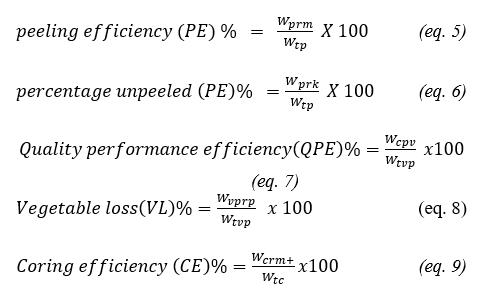
Where, Wprm= weight of peel removed with machine
Wprk = weight of uncut peel removed with knife
Wtp = weight of total peel
Wcpv = weight of completely peeled vegetable
Wvprp = weight of vegetative part removed along peel
Wtvp = weight of total vegetative part
Wcrm= weight of core removed with machine
Wtc = weight of total core
The data on different physical and mechanical properties of tender jackfruit at three stages of maturity (Stage I,II,III) and peeling time, peeling efficiency, percentage unpeeled, quality performance efficiency, vegetable loss, coring efficiency etc were analyzed with the help of analysis of variance (ANOVA) using XLSTAT 2017 software at 5% significant level. The critical difference amongst the average values of the variables were also compared to study the effect of the level of variables on the performance.
Results and discussion
Physical properties of tender jackfruit
The Size (Length and equivalent diameter), weight, diameter of core and peel thickness of tender jackfruit at different stages of maturity are shown in Table 1. The weight of the tender jackfruit increased from 1238.52 to 2383.34 g with increase in days of maturity from 30 to 90 days after flowering. The size of the jackfruit increased with days of maturity as the average lengths were22.0,21.80 and 27.22 cm at stages I, II, III respectively. Similarly, the equivalent diameter of the fruit was increased from 9.97±1.06 to 11.46±1.02 cm from 30 and 60 days of maturity and further increased to 12.88±0.79 up to 90 days of maturity. The average diameter of the core of jackfruit increases from 3.32 to 3.5cm and then 3.94 cm up to 60 days of maturity. The thickness of peel of the fruit were 9.2, 7.4, and 6.8 cm: the value was more at initial stage of maturity than rest two which means thickness of peel decreased with increase in maturity of the jackfruit. There is a constant increase in core diameter as the maturity of the fruit was advanced. The increase in weight, length, sphericity and core diameter of jackfruit were statistically insignificant (p<0.05) between 30 and 60 days of maturity, whereas there is significant difference between 60 to 90 days of maturity. However, the difference in size of equivalent diameters of the tender jackfruit were statistically significant (p < 0.05) between different stages of maturity from 30 to 90 days. Similar types of results were also reported by Rana et al., (2018). As the equivalent diameter of the tender jackfruit was increased with maturity as a consequence the surface area were also increased from 676.74cm2to 1218.32cm2.
From the observations of physical properties of three categories, it was clearly indicating that the size was increasing from first category to third category. Statistical analysis showed that for different dimensions of tender jackfruit such as weight, length, equivalent diameter, diameter of core and thickness of peel was significantly different (P < 0.05) between different maturity stages. However, the study results of the unripe jackfruit reported by Rupnawar et al., (2016), mentioned that the average weight was in the range of 7-10 kg and average diameter was 32.35 cm and length was 40.4 cm which were reduced by about 20 percent up on ripening. This may be because the stages of maturity of unripe jackfruit selected in their case corresponded to the fully matured stage and just before the ripening stage unlike the tender stage categorised in the present study.
| Property | Tender Jackfruit at different stages of maturity | ||
| Stage I | Stage II | Stage III | |
| Weight (g) | 1238.52a±135.67 | 1451.90a±173.68 | 2383.34b±292.38 |
| Length (cm) | 22a±1.58 | 21.80a±1.30 | 27.22b±0.70 |
| Equivalent dia. (cm) | 9.97a±1.06 | 11.46b±1.02 | 12.88c±0.79 |
| Sphericity | 0.68a ± 0.02 | 0.69a ± 0.04 | 0.76b ± 0.04 |
| Diameter of core (cm) | 3.32a±0.11 | 3.50a±0.23 | 3.94b±0.40 |
| Surface area (cm2) | 676.74a±45.24 | 971.47b±107.26 | 1218.32c±96.88 |
| Thickness of peel (cm) | 0.92a±1.3 | 0.74b±8.9 | 0.68c±0.84 |
| MCVP (%db) | 85.9a ± 1.4 | 87.9bc ± 1.0 | 88.6c ± 0.8 |
| MCP (%db) | 80.8a ± 0.6 | 81.6ab ± 0.4 | 82.3b ± 1.0 |
| Vegetable to peel ratio | (0.8± 0.1):1a | (1.0± 0.2):1a | (1.3± 0.2):1b |
| TPC (%) | 55.33a± 4.93 | 48.53a ± 5.78 | 42.33b± 4.88 |
| Cutting force (N) | 215.1a± 7.7 | 291.7b± 9.2 | 322.3c± 9.1 |
| Shear force (N) | 281.0c± 9.9 | 234.6b± 5.6 | 169.8a± 11.7 |
| Hardness of VP (N) | 27.4c± 0.5 | 24.2b± 1.4 | 20.1a± 0.6 |
| Same rows having different subscript had significant difference in properties at p<0.05, NS –Non significant | |||
Moisture content of the vegetative part (MCVP) and peel (MCP) of jackfruit at different stages of maturity were given in Table 1. The moisture contents of vegetative part increased from 85.9 to 88.6% (db) with growing maturity from 30 to 90 days. Similarly, the moisture content of the peel increased from 80.8 to 82.3% (db).It is evident that, with increase in jackfruit maturity, moisture content in vegetative as well as peel is increasing simultaneously. Contrary to this, many studies have suggested that with increase in maturity of vegetable up to over- matured stage the moisture content of vegetable and peel are reducing with days of maturity. Rana et al., (2018) had reported that the moisture content of bulb was significantly affected by harvesting times. The percentage of moisture content was decreased as the harvesting delayed. For hard variety jackfruit, moisture content (w.b) decreases from 89.5 to 74.4% as the stage changes from 1 to 4. For soft variety, the moisture content (w.b) decreased from 92.8 to 78.8%, as the stage changes from 1 to 4, respectively.
However, in the present context, with the selected maturity stages of jackfruit, up to 90 days after flowering, the fruit may not have shredded its moisture content and become dried with matured to over-matured stage. As this fruit remains in tender stage up to 90 days, moisture content is not reducing, but, increasing with maturity stages. Statistical evaluation showed that there was significant difference (p<0.05) with vegetative moisture content in first vs second stages, and first vs third stages. But there was no significant (at p<0.05). difference between second and third stages For peel moisture content, there was not significant difference in first vs second stages and second vs third stages.
The vegetable-to-peel ratio for first and second categories of jackfruits was0.8:1and 1.0:1, while for the third category this value was 1.3:1. The average theoretical peel content of tender jackfruit for the first and second categories were 55.33 and 48.53%, but for third category its value was 42.33% which was less than first two categories. With increased in size of tender jackfruit, theoretical peel contents were significantly reduced with maturity stages, lowest being at stage III maturity stage. It means, with increase in days of maturity, the weight and size of tender jackfruit is increased, more vegetative part is developed, however, the theoretical peel content (%) became less from stage I to stage III (55.33to 42.33 %).
Mechanical properties of tender jackfruit
Mechanical properties of vegetables such as cutting force, shear force and at three stages of maturity were evaluated from the force displacement graph and are given in Table 1. The cutting force of jackfruit increased with increase in days of maturity from 251.1 N to 322.3 N, whereas the shear force tends to decreased from 281.0 to 169.8 N. The hardness values of vegetative part wasreduced with increased stage of maturity. It was evident, that with increased maturity stage of the tender jackfruit it resulted in increase in cutting forces, but the shear force and hardness of vegetative part were decreased, which indicates that the vegetable tends to get softer and softer with increase in maturity stage of the jackfruit. Statistical analysis of mechanical properties of tender jackfruit were significantly (p<0.05) different with the stages of maturity.
Performance evaluation of developed machine and optimized parameters of operation
Performance evaluation of peeling, slicing and coring of tender jackfruite.g. processing time, peeling efficiency, quality performance efficiency, vegetable loss and coring efficiency with the developed cutting machine were shown in Table 2. Different sizes of blades were made for cutting of vegetable at three different sizes of tender jackfruit corresponding to the maturity stage of 30,60 and 90 days after fruiting. Cutting blade sizes of 75, 85 and 105mm were taken for different size/weight of tender jackfruit i.e. 1 to 1.5 kg, 1.5 to 2.0 kg and 2.0 to 2.5 kg respectively.
| Performance parameter | Blade size of cutting machine (diameter in mm) | LSD | ||
| 75 | 85 | 105 | ||
| PT (min) | 2.48a ± 0.4 | 3.1b ± 0.1 | 3.4c± 0.3 | 0.47 |
| PE (%) | 91.76a ± 0.4 | 89.32b ± 0.3 | 88.63b ± 2.2 | 1.89 |
| QPE(%) | 91.46a± 3.3 | 92.42c ± 0.5 | 83.95b± 3.6 | 4.02 |
| VL (%) | 8.5a ± 3.3 | 7.5a ± 0.5 | 16.33b± 4.0 | 4.18 |
| CE (%) | 87.6± 1.9 | 85.84 ± 5.8 | 88.61± 2.9 | NS |
| Capacity (kg/h) | 27.0 | 19.0 | 17.0 | |
| Same rows having different subscript had significant difference in properties at p<0.05, NS –Non significant | ||||
Capacity of peeling, decoring and slicing of jackfruit with the developed prototype machine varied with the size of the cutting blade from 27 to 17 kg /h with respect to blade size 75 to 105 mm, highest capacity being observed at 75 mm blade size which is suitable for small size jackfruit of stage I with corresponding weight of fruit as 1238.52±135.67 g (Table 2). High peeling efficiency with less mechanical damage or vegetative loss as well as less percentage unpeeled were the criteria for selection of the optimum variables for peeling, slicing and decoring of tender jackfruit. Peeling efficiency is highest for 1st category of fruit (91.76 %) followed with 2nd category (89.32%). Quality performance efficiency is highest in 2nd category (92.42 %) of jackfruit as well as the vegetative loss (7.5%) is minimum. Decoring efficiency had least difference among the different categories (non-significant, (p<0.05). Therefore, considering all the performance parameters, it was decided that fruit size of 60 days maturity corresponding to fruit weight of 1.5 to 2.0 kg, equivalent diameter 11.42 cm was suitable for peeling coring and slicing of jackfruit with 85 mm blade size of the machine.
Conclusions
All the physical parameters of jackfruits i.e. length, width, equivalent diameter, core diameter and surface area increased with increased maturity from 30 to 90 days, whereas, the peel thickness was decreased. With increased in size of tender jackfruit/ maturity the vegetative content was more than peel content. It was observed that second category jackfruit was stronger in mechanical properties in Istand IInd stages than third stage. Prototype cutting machine was developed for tender jackfruit with overall dimensions of 910 x 520 x 520 mm. The performance evaluation of the machine showed peeling efficiencies was highest i.e. 91.76 % for the first stage of jackfruit, whereas, it was decreased to 89.32, 88.63 % respectively with increased maturity. The quality performance efficiency was highest (92.42%) for second stage jackfruit. Vegetable loss percentage was lowest for second i.e., 7.5 %, and highest (16.33%) in third stage of maturity of fruit. Considering all the performance parameters, it was decided that fruit size of 60 days maturity corresponding to fruit weight of 1.5 to 2.0 kg, equivalent diameter 11. 42 cm was most suitable for peeling, coring and slicing of jackfruit with 85 mm blade size of the developed prototype machine having maximum quality performance efficiency (92.42%), peeling efficiency (89.32%) and less vegetative loss (7.5%).
Acknowledgement
The authors acknowledge the financial support rendered by the Indian Council of Agricultural Research, New Delhi at All India Co-ordinated Research Project on Post Harvest Engineering and Technology, and the facilities provided by Department of Agricultural Process and Food Engineering, College of Agricultural Engineering and Technology, Odisha University of Agriculture and Technology, Bhubaneswar.
Conflict of Interest: The authors declare no conflict of interest.
References
- Adetan DA, Adekoya LO and Aluko OB. (2006). Theory of mechanical method of peeling cassava tubers with knives. Journal of Institute of Agrophysics,20: 269 – 27
- Bahnasawy AH, El-Haddad ZA, EI-Ansary MY and Sorour HM. (2004). Physical and mechanical properties of some Egyptian onion cultivars. Journal of Food Engineering. 62 (3): 255-261.
- Brown HE, Meredith FI, Saldana GS and Stephens TS. (1970). Freeze peeling Improves quality of tomatoes, Journal of Food Science. 35:485-488.
- Caceres LG, Andrade JS, da Silva Filho DF. (2012). Effects of peeling methods on Quality of cubiu fruits, Food Science and Technology.32(2):255–260.
- Emadi B, Kosse V, K dv Yarlagadda, P.(2007). Abrasive Peeling of Pumpkin, Journal of Food Engineering, 79 (2), 647-656
- Jahanbakhshi A. (2018). Determination of some engineering properties of snake melon (cucumismelovar.flexuosus) fruit, Agricultural Engineering International, CIGR Journal, 20 (1), 171-176
- Mazlina MKS, Aliaa ARN, Hidayati HN, Shima MSIS and Zuha WHW. (2010). Design and Development of an apparatus for grating and peeling fruits and vegetables, American Journal of Food Technology, 5 (6): 385-393
- Rana S.S., Pradhan, R.C. and Mishra S. (2018). Variation in properties of tender jackfruit during different stages of maturity,J Food Science Technol., 55(6): 2122–2129
- Rupnawar HD, Sawant AA, Thakor NJ, Swami SB and Patil AP. (2016). Physical properties of Jackfruit (Artocarpus Heterophyllus Lam.) and its components. Internat. Journal of Processing& PostHarvest Technology, 7 (2): 171-178. Doi: 10.15740/Has/Ijppht/7.2/171-178
- Singh SS and Shukla BD.(1995).Abrasive peeling of potatoes. Journal of Food Engineering, 26, 431-442.
- Siti MK and Shima MS. (2010). Design and development of apparatus for grating and peeling fruit and vegetable. American Journal of Food Technology, 5 (6), 385-393.
- Sonawane SP, Sharma GP, Pandya AC.2011. Design and development of power operated banana slicer for small scale food processing industries. Research in Agricultural Engineering,57: 144–152.
- Thakur S and Vidyasagaran K. (2014). Influence of zonal variation on physical characteristics of Artocarpus hirsutismfruit and sizewise variation in biochemical composition of the Fruit. Journal of Recent Advances in Agriculture, 2 (6): 263-270.
- Wangyang. (2013). Combined Watermelon Cutter. Us Patent Document Cn203109987U.