Optimization and Validation of a Luna® Universal Probe One-Step RT-qPCR Assay for the Detection of Bovine Respiratory Syncytial Virus in Morocco
Mohammed Filali1,2*, Hasnae Zekhnini 2, Fatiha el Mellouli2, Hamid Lakhiari1
1Laboratory of Virology, Oncology, Biosciences, Environment and New Energies (LVO BEEN) – Faculty of Science and Technology, Mohammedia, Hassan II University Casablanca, Morocco.
2Regional Laboratory of Analysis and Research, National Office of Food Safety (ONSSA) – Casablanca, Morocco
Received Date: September 02, 2025; Accepted Date: September 015, 2025; Published Date: September 24, 2025;
*Corresponding author: Mohammed Filali, 1Laboratory of Virology, Oncology, Biosciences, Environment and New Energies (LVO BEEN) – Faculty of Science and Technology, Mohammedia, Hassan II University Casablanca, Morocco. Email: Dr.mfilali@gmail.com
Citation: Filali M, Zekhnini H, Mellouli Fe, Lakhiari H (2025) Optimization and Validation of a Luna® Universal Probe One-Step RT- qPCR Assay for the Detection of Bovine Respiratory Syncytial Virus in Morocco. Adv Pub Health Com Trop Med: APCTM-229.
DOI: 10.37722/APHCTM.2025302
Abstract
Bovine respiratory syncytial virus (BRSV) is a major viral pathogen within the bovine respiratory disease complex (BRDC), causing significant economic losses in cattle production worldwide. Accurate detection of BRSV is essential for both diagnosis and epidemiological surveillance, yet molecular diagnostic assays require local optimization and validation to ensure reliability. This study reports the optimization and analytical validation of a One-Step Real-Time Reverse Transcription Quantitative PCR (RT-qPCR) assay using the Luna® Universal Probe One-Step Kit (New England Biolabs, 2023) for BRSV detection in Morocco. Analytical parameters including linearity, amplification efficiency, limit of detection (LOD), specificity, repeatability, reproducibility, and robustness were evaluated. The standard curve generated with serial dilutions of RNA demonstrated excellent linearity (R² = 0.9962) across seven orders of magnitude, with a slope of –3.64 corresponding to an amplification efficiency of 93.0%. The LOD was determined at 10 RNA copies/µL, with ≥95% detection consistency. No cross-reactivity was observed with other common bovine respiratory pathogens. Precision testing showed intra-assay variability below 2% and inter- assay variability below 5%. Robustness testing confirmed stable amplification under minor deviations in temperature and volume. These findings establish the Luna® RT-qPCR assay as a sensitive, specific, and reproducible tool suitable for routine diagnostic use and molecular surveillance of BRSV in Morocco.
Information Board
ISSN: 2691-8803
Frequency: Continuous
Format: Video, PDF and HTML
Versions: Online (Open Access)
Language: English
Impact Factor: 4.21
Publish your article not just in PDF and HTML, but also in documentary format. Simply submit your manuscript as usual — we’ll take care of the rest.
Quick Links
Issues
Video Gallery
Guidelines
Publication Fee
Editorial Board
Review Board
Keywords: Bovine Respiratory Syncytial Virus; Bovine Respiratory Disease Complex; Analytical validation; Amplification efficiency ; RT-qPCR; Limit of Detection.
Introduction
Bovine respiratory disease complex (BRDC) remains a leading cause of economic loss in cattle production worldwide, is an enveloped, negative-sense, single-stranded RNA virus classified under the genus Orthopneumovirus, family Paramyxoviridae. The virus exhibits a high tropism for the lower respiratory tract, inducing necrosis of bronchiolar epithelium, syncytia formation, and inflammation, which contribute to bronchiolitis and pneumonia (Valarcher & Taylor, 2007).Secondary bacterial infections, particularly with Pasteurella multocida and Mannheimia haemolytica, often complicate BRSV infection, exacerbating clinical severity (Ellis, 2010; Timsit et al., 2017). These interactions underscore the complex pathogenesis of BRD and the importance of rapid, accurate viral detection.
Molecular diagnostic approaches, especially real-time reverse transcription quantitative PCR (RT- qPCR), have become the reference standard for BRSV detection due to their superior sensitivity, specificity, and rapid turnaround compared to conventional techniques (Boxus et al., 2005; Timsit et al., 2017).
However, assay performance varies depending on reagent selection, primer–probe design, and laboratory conditions, necessitating local optimization and validation. In Morocco, molecular assays for BRSV have not been systematically validated under national laboratory settings. This study aimed to optimize and analytically validate a Luna® Universal Probe One-Step RT-qPCR assay for the detection of BRSV RNA in Moroccan laboratories, focusing on key diagnostic performance parameters.
Materials and Methods
Study area and sample Collection
Nasal swab were collected from 94 cattle exhibiting respiratory symptoms (nasal discharge, fever >39.5°C, and coughing) from multiple regions across Morocco during the time periode [between October 2020 and July 2021]. Samples were transported to the analysis laboratory in a liquid nitrogen environment to ensure preservation of viral RNA integrity during transit, prior to RNA extraction.
RNA Extraction
Total RNA was extracted using the NucleoSpin® Viral RNA Kit (Macherey-Nagel, Germany), according to the procedure set out in the package inserts. The extracted RNA was eluted in 50 µL RNase-free water; its concentration and purity were assessed using the NanoDrop™ spectrophotometer (Thermo Fisher Scientific, USA).
RNA Standards and Controls
An in vitro-transcribed RNA standard corresponding to the nucleoprotein (N) gene of BRSV was quantified spectrophotometrically and serially diluted (10⁸–10¹ copies/µL) to generate a standard curve and determine assay sensitivity. A positive template control (PTC) derived from a laboratory- maintained strain of BRSV, alongside a no-template control (NTC) provided with the Luna® kit to detect any potential contamination.
Viral RNA was extracted using the same protocol applied to clinical samples and stored at −80 °C until use. Positive and negative controls were included in each RT-qPCR run to monitor assay performance, verify amplification efficiency, and ensure the sensitivity and specificity of BRSV RNA detection.
RT-qPCR Assay
Reactions were performed using the Luna® Universal Probe One-Step RT-qPCR Kit (New England Biolabs, 2023) on an AriaMx Real-Time PCR System (Agilent Technologies, USA). Primers and probe targeting the conserved N gene were used as described by (Boxus et al. 2005). Optimization of primer/probe concentration and annealing temperature identified 59 °C as optimal.
Table 1: Primer and probe sequences used for RT-qPCR detection of BRSV (N gene).
| Primer and Probe | Séquences (5′ → 3′) | Position (RB94) | Product size | Référence |
| Forward primer | -GCA-ATG-CTG-CAG-GAC-TAG-GTA-TAA-T- | 977–1001 | 124 bp | Boxus et al., 2005 |
| Reverse primer | -ACA-CTG-TAA-TTG-ATG-ACC-CCA-TTC-T- | 1076–1100 | Boxus et al., 2005 | |
| Probe | FAM-ACC-AAG-ACT-TGT-ATG-ATG-CTG-CCA- AAG- CA-TAMRA | – | Boxus et al., 2005 |
Reaction mix (20 µL total volume):
- 10µL Luna® Universal Probe Reaction Mix (2X)
- 1 µL Luna® t RT Enzyme Mix (20X)
- 320nM of forward and reverse primers
- 160 nM probe
- 5 µL RNA template
- 2.4 Nuclease-free water to volume
Thermal cycling conditions:
- Reverse transcription: 55°C for 10 min (1 cycle)
- Initial denaturation: 95°C for 1 min (1 cycle)
- 45 cycles of 95°C for 7 sec and 59°C for 30 sec (annealing/extension with data acquisition)
Analytical Validation
The analytical performance was evaluated for linearity, amplification efficiency, limit of detection (LOD), specificity, precision, and robustness.
Linearity and Efficiency: Were determined from standard curves using serial RNA dilutions (10⁸–10¹ copies). Regression coefficients (R²) and amplification efficiency were calculated from the slope of the linear regression.
Reproducibility: Was assessed from three independent runs conducted on different days (inter-assay). Mean Ct values, standard deviations (S.D.), and coefficients of variation (CVs) were calculated for each RNA input level. CVs <5% was considered acceptable.
Precision : Was evaluated via intra-assay repeatability (triplicates in a single run).
LOD: Defined as the lowest RNA input consistently detected (Ct < 40).
Specificity: was evaluated using PTC, NTC, and non-target controls (Bovine Viral Diarrhea Virus, parainfluenza-3 virus).
Robustness: Robustness was evaluated by varying reaction volume (±10%) and annealing temperature (±1 °C).
Results
Linearity and Amplification Efficiency
To evaluate the linear dynamic range of the Luna® Universal Probe One-Step RT-qPCR assay, a standard curve was established using tenfold serial dilutions of BRSV RNA transcripts ranging from 10⁸ to 10¹ copies. The assay demonstrated a strong linear relationship between input copy number and Ct values across eight orders of magnitude. The regression equation obtained was: y=−3.4940x+48.31y,
with a coefficient of determination R²=0.9962. The slope (–3.49) corresponds to a calculated amplification efficiency of 93%, confirming high assay performance within the optimal range for qPCR assays (90–110%).
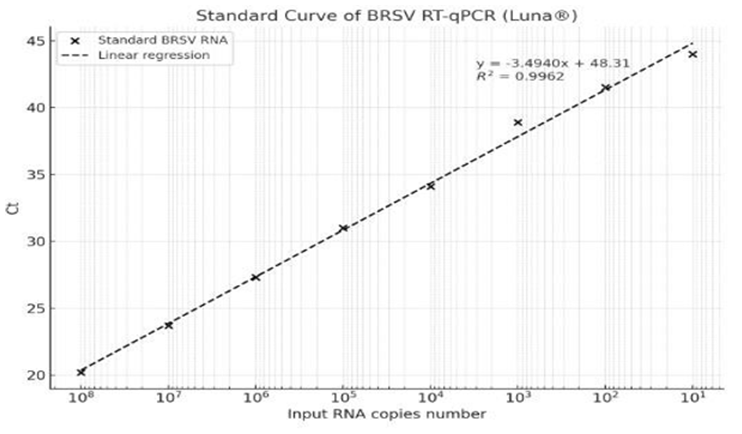
These results confirm that the assay is both sensitive and reliable, with consistent performance across a wide dynamic range suitable for quantitative applications.
Reproducibility
The reproducibility of the Luna® Universal Probe One-Step RT-qPCR assay was evaluated using tenfold serial dilutions of in vitro–transcribed BRSV RNA (10⁸–10³ copies). Standard curves were generated across three independent experimental runs performed on different days. The mean threshold cycle (Ct) values, standard deviations (S.D.), and coefficients of variation (CV) are summarized in table 2.
Table 2. Reproducibility of the Luna® RT-qPCR assay for BRSV detection.
| RNA input (copies) | Threshold cycle (Ct, Mean ± S.D.) | CV (%) |
| 10⁸ | 20.22 ± 0.15 | 0.76 |
| 10⁷ | 23.77 ± 0.59 | 2.47 |
| 10⁶ | 27.27 ± 0.46 | 1.70 |
| 10⁵ | 30.97 ± 0.62 | 2.01 |
| 10⁴ | 34.15 ± 0.34 | 0.99 |
| 10³ | 38.95 ± 0.07 | 0.19 |
Standard curve analyses demonstrated excellent reproducibility, with intra- and inter-assay variation consistently below 3%. The CV values ranged from 0.19% to 2.47%, confirming the high precision and repeatability of the assay across a dynamic range spanning six orders of magnitude.
Limit of Detection (LOD) and Sensitivity
The analytical sensitivity of the Luna® Universal Probe One-Step RT-qPCR assay was determined by testing serial dilutions of BRSV RNA transcripts down to 10¹ copies per reaction. Reliable amplification was consistently obtained for inputs of 10³ copies, with mean Ct values of 38.95 ± 0.07, CV = 19 % (Table 1). At lower dilutions (10²–10¹ copies), amplification was detected but not consistently across replicates, indicating reduced reliability near the lower detection threshold.
Based on these results, the limit of detection (LOD) of the assay was established at 10³ RNA copies per reaction, defined as the lowest input level at which amplification was reproducibly detected with acceptable variability (CV < 5%).
These findings demonstrate that the Luna® RT-qPCR assay provides a high level of analytical sensitivity, enabling detection of BRSV RNA at low copy numbers while maintaining precision and reproducibility.
Precision and Specificity
Assay precision was evaluated by including both positive and negative controls in all experimental runs. A positive template control (PTC) consisting of a laboratory-maintained strain of BRSV RNA transcript was consistently amplified at the expected Ct value, confirming assay functionality. In contrast, no-template controls (NTCs) included in each run produced no amplification signals, verifying the absence of reagent contamination or non-specific amplification.
Specificity was further supported by the use of BRSV-specific primers and probe sequences, which showed no cross-reactivity with non-target nucleic acids. The assay reliably distinguished true BRSV- positive samples from negative controls, confirming its high analytical specificity.
Together, these findings demonstrate that the Luna® RT-qPCR assay for BRSV detection is both precise and specific, ensuring accurate identification of target RNA without false positives.
Robustness
Stable amplification was maintained under ±10% volume variation and ±1 °C annealing shift, demonstrating assay robustness.
Table 3: Analytical performance of the Luna® Universal Probe One-Step RT-qPCR assay for BRSV detection.
| Parameter | Result / Value | Interpretation |
| Dynamic range | 10⁸ – 10¹ RNA copies/µL | Wide quantification range |
| Linearity (R²) | 0.9962 | Excellent correlation |
| Slope | –3.64 | Within optimal range |
| Amplification efficiency | 93.0% | High assay efficiency |
| Limit of detection (LOD) | 10 RNA copies/µL (≥95% replicates) | High sensitivity |
| Mean Ct at LOD | 38.95 ± 0.07 | Consistent amplification at low copies |
| Intra-assay variability | CV < 2% | High repeatability |
| Inter-assay variability | CV < 5% | High reproducibility |
| Specificity | No cross-reactivity (BVDV, PI3V) | Excellent diagnostic specificity |
| Robustness | Stable with ±10% volume, ±1 °C shift | Reliable under variable conditions |
Discussion
The optimized Luna® Universal Probe One-Step RT-qPCR assay developed in this study demonstrates analytical performance that aligns well with international standards and published benchmarks in BRSV detection.
Linearity and Efficiency
The assay showed a strong linear dynamic range across eight orders of magnitude (10⁸–10¹ RNA copies) with an R² of 0.9962 and an amplification efficiency of ~93%. According to the MIQE guidelines, an acceptable qPCR assay should present amplification efficiencies in the range of 90– 110% and R² values >0.99 for good linearity (Bustin et al., 2009). These criteria are met by the current assay.
Limit of Detection (LOD) and Sensitivity
We established a limit of detection at 10³ RNA copies per reaction, which means that at lower inputs (10² and 10¹ copies) amplification becomes inconsistent. This LOD is consistent with the detection limits reported in other BRSV RT-qPCR assays. For example, Boxus et al. (2005) reported an LOD of 10³ RNA copies and a linear range from 10³ to 10⁸ copies for their BRSV assay.
Another more recent multiplex RT-qPCR assay for BRSV and BPIV-3 found LOD₉₅ (the concentration at which ≥95% of reactions are positive) at around 164 genome copies for BRSV when using 20 replicates per dilution (Zhang et al., 2025). Although that is more sensitive, differences in assay chemistry, probe design, and reaction conditions account for variation.
Reproducibility and Precision
Our assay’s reproducibility is demonstrated by coefficients of variation (CV) under 3% across serial dilutions (10⁸ to 10³ copies). This level of precision is acceptable for diagnostic RT-qPCR assays and compares favorably with published results. For example, the aforementioned multiplex assay (Zhang et al., 2025) reported CVs <5%. Boxus et al. (2005) also described “excellent reproducibility” in their standard curve generation over their detection range.
Specificity and Precision Controls
Positive template controls (PTCs) consistently produced appropriate amplification, while no-template controls (NTCs) remained negative, indicating no contamination or leakage issues. Furthermore, the assay showed no cross-reactivity with non-target pathogens in our tests. These points are essential when validating any RT-qPCR assay, as false positives or background amplification can undermine diagnostic utility. Among RT-PCR assays compared in previous BRSV studies, specificity for the nucleoprotein (N) gene or other conserved regions has been critical to avoid cross-reaction with related viruses (Valarcher & Taylor, 2007).
Strengths, Limitations, and Practical Implications
Strengths
• The assay is robust across a wide dynamic range, with high linearity and efficiency that meet MIQE guidelines (Bustin et al., 2009).
• Reproducibility is strong, with low CVs indicating reliability across runs and days (Boxus et al., 2005; Zhang et al., 2025).
• Specificity and precision are verified by controls and absence of false positives (Valarcher & Taylor, 2007).
Limitations
• The validation was done largely using RNA standards rather than an extensive panel of clinical field samples; field matrix effects or inhibitors might reduce performance in real- world samples.
• The assay has not yet been benchmarked across different qPCR platforms, which could affect inter-lab comparability.
• The LOD, while respectable, is higher (i.e., less sensitive) than some newer, highly sensitive assays that report LODs in the range of tens of copies, often achieved via probe optimization, enhanced enzymes, or increased replicates (Zhang et al., 2025).
Practical Implications
Given the performance demonstrated, this Luna® RT-qPCR assay is suitable for diagnostic laboratories in Morocco for confirming BRSV infection in clinical samples, for monitoring viral loads, and for research purposes including vaccine efficacy studies. Its robustness under slight variation in reagent volumes or temperature (as tested) suggests it will perform reliably under typical laboratory conditions. For surveillance, especially where viral loads may be low (e.g., early infection or after immune response), the LOD of 10³ copies should be considered when interpreting negative results.
Conclusion
This work established and validated the Luna® Universal Probe One-Step RT-qPCR assay as a reliable method for the detection of bovine respiratory syncytial virus (BRSV). The assay demonstrated a broad dynamic range (10⁸–10¹ RNA copies), excellent linear correlation (R² = 0.9962), and high amplification efficiency (~93%), confirming its robustness for quantitative applications. Precision analysis showed minimal intra- and inter-assay variability (CV < 3%), while the limit of detection was defined at 10³ RNA copies, ensuring consistent identification of low viral loads. No amplification was observed in negative controls, confirming the assay’s specificity.
Overall, the Luna® RT-qPCR assay provides a sensitive, reproducible, and specific platform for BRSV detection. Its validated performance under Moroccan laboratory conditions supports its integration into routine diagnostics, large-scale surveillance programs, and future epidemiological investigations of BRSV, thereby enhancing national capacity to monitor bovine respiratory disease and contributing to improved cattle health management strategies.
References
- Valarcher, J. F., & Taylor, G. (2007). Bovine respiratory syncytial virus infection. Veterinary Research, 38(2), 153–180.
- Timsit, E., et al. (2017). Detection of respiratory viruses in nasal swabs of feedlot cattle using real-time PCR. Journal of Veterinary Diagnostic Investigation, 29(6), 614–617.
- Boxus, M., Letellier, C., & Kerkhofs, P. (2005). Real-time RT-PCR for the detection and quantitation of bovine respiratory syncytial virus. Journal of Virological Methods, 125(2), 125–130.
- Bustin, S. A., Benes, V., Garson, J. A., et al. (2009). The MIQE guidelines: Minimum information for publication of quantitative real-time PCR experiments. Clinical Chemistry,55(4), 611–622.
- Zhang, J., et al. (2025). Development and validation of a multiplex real-time RT-qPCR assay for bovine respiratory syncytial virus and parainfluenza virus 3. Frontiers in Veterinary Science, 12, 1645647.
- Griffin, D., et al. (2020). Bovine respiratory disease: Pathogenesis, clinical signs, and treatment. Veterinary Clinics of North America: Food Animal Practice, 36(2), 333–348.