Secure Land Tenure in Customary Land: Opportunities or Not?
Godiramang Motlhagodi*
Director, Afriq Research Institute for Human Settlements, Botswana
Received Date: January 05, 2026; Accepted Date: January 24, 2026; Published Date: February 26, 2026;
*Corresponding author: Godiramang Motlhagodi, Director- Afriq Research Institute for Human Settlements, Botswana, Email: geemotlha@gmail.com
*Corresponding author: Mac’Were Ouma Enos, Jaweta Fish Fish Farms Ltd, P.O. Box 171-40301 Kendu Bay, Homa Bay County, Kenya. Email: emacwere@gmail.com, info@jawetafishfarms.com
Citation: Motlhagodi G (2026); SCA 04- Secure Land Tenure in Customary Land: Opportunities or Not? Enviro Sci Poll Res and Mang: ESPRM-177
DOI: 10.37722/ESPRAM.2026106
Information Board
ISSN 2692-1529
Frequency: Continuous
Format: Video, PDF and HTML
Versions: Online (Open Access)
Language: English
Impact Factor: 4.21
Secure land tenure and property rights (LTPR) have long been recognized as a foundation for economic growth in both rural and urban areas. It is defined as the perception of an individual or a community concerning his/her/their rights to a piece of land constantly, free from the threat of eviction and interference from outside sources (Abdillah, 2022). Land titling is critical to spatial framework as it allows for mapping and collecting land and property rights information on land parcels.
Studies have revealed different levels of progress across regions in terms of formalization of land rights. In South and East Asia, Latin America, Eastern Europe, and the post-Soviet countries, significant land rights have been formalized through land titling by the state, and titling is proceeding on a significant scale. In sub-Saharan Africa, where customary land tenure systems prevail, the level of protection provided varies widely within and between countries. There is significant diversity in the ability of these customary tenure systems to provide security and predictability in contractual obligations and in the definition and scope of transfer rights afforded to parties.
The main research question of the study was whether the registration of customary land presents opportunities or challenges. To answer this question, the study had the following objectives. Firstly, to explore case studies from different countries where customary land registration was implemented. Secondly, the study examined the benefits of land registration and lastly to evaluate the impact of customary land registration to land administration. The study adopted a comparative approach using cases from four (4) countries, Botswana, Malawi and Uganda from Africa and Indonesia from Asia, on approaches used to secure customary land and property rights. The opportunities and challenges experienced by the countries in the registration of customary land and the impact of customary land registration on security of tenure was also explored across the four(4) countries. In the Indonesia, case studies indicated that customary land does not get the recognition as other tenures. The context of Botswana, Malawi and Uganda revealed secure land tenure implemented in customary land resulted in better conflict resolution mechanisms, access to economic opportunities and better management of customary land. On the other hand, Indonesia displayed that the only about 13% of customary land has been formally registered.
Key Takeaways
- Customary land rights struggle in Indonesia emerged subsequently after the collapse of Suharto’s authoritarian regime in 1998.
- State laws and regulations began to accommodate interests of customary communities, while rural populations simultaneously utilized the political space afforded by these laws to (re)claim customary rights over land and forest. But the laws have been hardly implemented.
- A study examined the strategies used by three (3) local communities to secure their land rights and explained different outcomes of these struggles.
- Another case was a success, another a failure and the third one was in between.
- In Malawi, a study was done to explore the implications of transformation towards digitalization from the district level, and the opportunities of data interoperability with other registries for efficiency and effectiveness of monitoring and evaluation.
- The results indicate that the transformation has improved adjudication of customary land parcels, customary land dispute mediation, increased the rate of certification and served to monitor effectiveness of customary land tribunals.
| Key Indicators | Chikwawa | Zomba / Machinga |
| # of parcels demarcated | 43,578 | 52,843 |
| # of parcels individually demarcated | 38,988 | 47,414 |
| # of parcels jointly demarcated | 4,590 | 5,429 |
| # of parcels registered | 39,990 | 44,918 |
| # of parcels individually registered | 35,932 | 40,763 |
| # of parcels jointly registered | 3,968 | 4,155 |
| Total Area of parcels adjudicated and demarcated | 16,626 ha | 17,413 ha |
| Average area of parcels adjudicated and demarcated | 0.38 ha/parcel | 0.33 ha/parcel |
| Average area of individually adjudicated and demarcated parcels | 0.34 ha/parcel | 0.31 ha/parcel |
| Average area of jointly adjudicated and demarcated parcels | 0.83 ha/parcel | 0.5 ha/parcel |
Source: Wells, et al, 2025
- The enablers of the transformation were identified as regulatory framework, electronic adjudication, certification procedure and human resource.
- The figure below represents the process involved in registration land in Botswana.
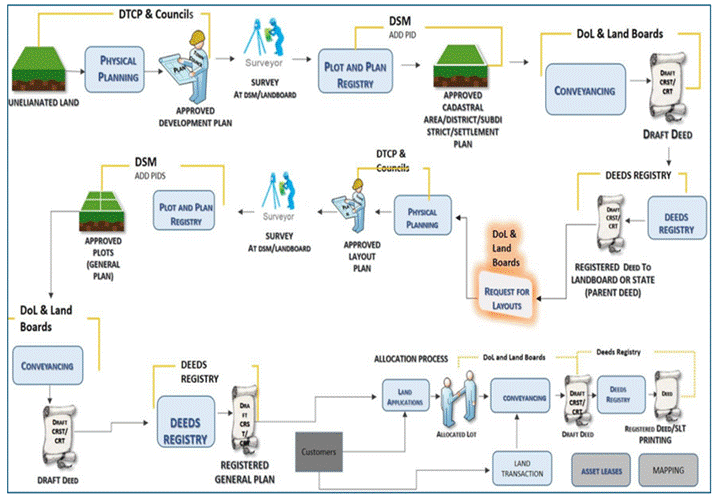
Source: Mogotsi, 2025
Presentation 1
Unpacking The Struggles of Indigenous (Adat) Communities for Securing Customary Land Rights in Indonesia: A Comparative Study
Andi Rahmat Hidayat, Public Administration and Policy group, Wageningen University and Research
“Capture by the elites was found in Sinjai and Pasankayo while absent in Enrekang.”
Customary land rights struggle in Indonesia has emerged subsequently after the collapse of Suharto’s authoritarian regime in 1998 and the country’s transition into a democratic and decentralized governance system. State laws and regulations began to accommodate interests of customary communities, while rural populations simultaneously utilized the political space afforded by these laws to (re)claim customary rights over land and forest that had been appropriated during Suharto’s New Order period. However, the laws have hardly been implemented. In line with this, little attention has been given to understanding the impact of democratization and decentralization on customary land rights recognition to explain why some communities have succeeded while others have not. The study addressed the gap by comparing three cases of customary land rights struggle in Indonesia with varying outcomes: Enrekang presents a successful case, Pasangkayu is a failed one, and Sinjai falls in between. This study particularly examined the strategies used by local communities to secure their land rights and explains different outcomes of these struggles by applying an analytical framework drawn from a systematic review on democratization and decentralization literature in Indonesia. Findings show that while clientelistic informal state institutions presumably undermine interests of marginalized groups, customary communities in Enrekang, and to a certain extent in Sinjai, utilized this to their favor. In contrast, rural communities in Pasangkayu lacked connections with influential politicians and were constrained by unresponsive district governments, purportedly due to collusive ties between politicians and the corporate plantation.
Presentation 2
Lessons From Digital Land Registry Systems: Evidence from Malawi
Jessica Wells, World Bank Consultant, World Bank
Thea Hilhorst, World Bank
Eunice Kaipsya, Land Reform Implementation Unit, Ministry of Lands, Malawi
Andrew Kafumbata, Land Reform Implementation Unit, Ministry of Lands, Malawi
Atumpele Luwayo, Land Reform Implementation Unit, Ministry of Lands, Malawi
“Reducing time and costs of the adjudication process is critical.”
This paper explored the implications of the transformation towards digitalization from the district level, and the opportunities of data interoperability with other registries for efficiency and effectiveness of monitoring and evaluation. For example, interoperability with the National ID cards in Malawi that include a QR code, allowed data collectors to scan the ID to obtain accurate identification information.
Agriculture sector is marked by disparity in land administration consisting of small holder farms who are under customary tenure and comprising up to 75% – 80% of agricultural land. Commercial agriculture is 20 – 25% and large tea/coffee estate are on freehold. Malawi embarked on registration of customary land and adopted a low-cost approach to adjudication to allow for nationwide coverage. A combination of digital, general boundaries, decentralisation, customary support villages through customary land committees and as a result supported gender sensitive and holistic approach to land governance. The process used involved decentralisation with new structures that incorporate traditional authorities and ensure participation by women. Establishment of customary Land Committee (CLC), chaired by Traditional Authority Group Village Head with 50% of the members being women.
The Land Information Management System (LIMS) in Malawi allows analysis on the number of parcels that have been adjudicated, the number of unique female applicants either owning land in their own name or on joint titles. The GPS data collected during the demarcation and adjudication processes allows further disaggregation by community, as well as whether applicants are owners, sole or joint, on multiple parcels in more than one community. Analysis of boundary disputes established that 150 land disputes have been recorded and digitized within the Shire Valley. Many disputes take place within the customary land certification project areas while others do not.
Presentation 3
Botswana’s Land Reforms: Improving Security of Tenure in Customary
Gopolang Mogotsi, Deputy Director, Department of Town and Country Planning, Ministry of Lands and Agriculture, Republic of Botswana
“Land shall be planned, surveyed and registered.”
“Botswana can serve as a model for customary land reform in Southern Africa through policy innovation and knowledge sharing”
Botswana provides good example where progressive improvements to customary land administration were made. Notable reforms include the vesting of customary land on a “Board” as opposed to the norm where the chief of a tribe was the only authority over land. This brought multiplicity in decision making, improved fairness and transparency in land allocations. The Botswana Land Policy, 2019, came up with targeted interventions which include registration and issuance of land titles to customary land holders; access to one free plot in tribal land regardless of one’s marital status; declaring Botswana as planning area and introducing affirmative actions. In 2022 land legislation was reviewed to operationalize these reforms.
Land Administration Processes Capacity and Systems (2008 – 2013) was implemented by Botswana Government and Lantmäteriet. With an overall objective for social and economic development based on efficient, effective and transparent land administration. The scope of the project was national systems for unique referencing of land parcels and location addresses, Improvement of land administration processes, Deeds Register computerisation, Systematic adjudication on tribal land, Development of IT procedures and organization, Exchange and dissemination of land administration data and lastly Training and Development.
In preparation for registration of customary land, there was a need to survey all land parcels in the tribal territories. These included all plots of different land uses including residential and ploughing fields. This was a massive land survey project where government and private surveyors were engaged. By the time of the commencement of the Tribal Land Act, 2018 in the year 2022 all land residential land parcels were surveyed and issued plot numbers, this was over 1million plots. Other land parcels continue to be surveyed with notable progress. Some Land Boards have already completed survey of ploughing fields in their areas of jurisdiction. As part of the reform the title of customary land ownership has also changed from Certificate of Customary Land Rights to a Deed of Customary Land Title or Secure Land Title as commonly referred to. The latter offers owners perpetual land rights and can be used as collateral in financial institutions, thus improving security of tenure.
Registration of Customary Grants has started at a very slow pace, with only 21,300 titles over a possible 950,000 registered (LIS System Report, 2025). This slow production and registration of customary grants haunts Botswana land management sector as citizens have high hopes of getting Secure Land Titles (SLT). It is a constant complaint which may lead to loss of trust and hope by the public on this noble development. The process of digitization of customary land records has lacked behind making it difficult and increasing the length of time to adjudicate on some land transactions. Challenges have also been encountered in preparation and registration of places in the old villages. Some of the standard land survey diagrams such as General Plans are difficult to prepare on the old village sites, leading to delays in SLT production. It is this lack of data readiness that has been the biggest impediment to the production of SLTs.
The implementation of customary land reforms introduced by Botswana met teething challenges such as low ICT uptake; poor connectivity to drive online services; poor data readiness to support automation; rejection of new taxes and service fees and unprecedented customary land grabbing by urban elites. There are opportunities to overcome some of the challenges, by adopting some technologies such as Block chain technology.
Presentation 4
Securing customary land and unlocking development: lessons from community based- land registration and land use planning on customary land in Uganda.
Teddy Kisembo (UN-Habitat/GLTN)
Simon Peter Mwesigye (UN-Habitat/GLTN)
Evelyne Ajambo (UN-Habitat/GLTN)
“To ensure food security and poverty reduction, it is essential to resolve the issues of access to land, security of tenure, and the ability to use land and natural resources in a sustainable and productive way”
Land, including wetlands, is essential to the livelihood of most Ugandans, as agriculture is the foundation of the country’s economy. About 70 percent of jobs in Uganda are in the agriculture sector, which also makes up about 24 percent of the country’s GDP and 42 percent of its export earnings. 80% of land in Uganda is held through a customary land tenure system, with a significant number of communities and families lacking formal documentation for their land access, leading to various land disputes and conflicts. To ensure food security and poverty reduction, it is essential to resolve the issues of access to land, security of tenure, and the ability to use land and natural resources in a sustainable and productive way.
The community-based land registration and land use planning on customary land project that aims to improve tenure security and promote sustainable land use through participatory and fit-for-purpose approaches. Utilizing participatory tools such as the Social Tenure Domain Model, Tenure Responsive Land Use Planning, Gender Evaluation Criteria and Rapid Physical Planning Appraisal, the project mapped 18,997 land parcels, benefiting 22,472 individuals. Over 105 land disputes were resolved via Alternative Dispute Resolution, while Physical Development Plans and wetland management frameworks were advanced in targeted sub-counties. Capacity-building initiatives trained 1,253 stakeholders, including district officials and youth, and community sensitization reached 6,623 participants through meetings and radio campaigns.
By fostering inclusive governance, gender-responsive approaches, and sustainable practices, the project strengthens Uganda’s land administration systems, ensuring equitable access for vulnerable groups and promoting long-term environmental and socio-economic resilience. These efforts underscore the critical role of community engagement, adaptive strategies, and policy alignment in achieving scalable land tenure security and sustainable rural development.
Recommendations
The session has identified that there are opportunities and challenges in efforts and programmes that were undertaken to improve security of customary land tenure. The opportunities outweigh challenges and from the case studies it is evident that there are foundational issues that need to be addressed in order to have success in achieving security of customary land rights.
It is recommended that land authorities use digital technology in land records management in order to drive mechanisms to survey, register and distribute customary land rights. As recommended by Botswana the use of Block Chain Technology is key to the success of reforms in securing customary land rights. Furthermore, training and capacity building for stakeholders and community are critical to the success of reforms geared towards secure customary land rights.
Additionally, the legislative and institutional framework is a critical element in the reforms on securing tenure in customary land rights. This is key in creating a conducive environment for the implementation of the intended reforms.