Bioactive Compounds Analysis and Antioxidant Evaluation of Chromolaena odorata (L) for Development of Anti-Inflammatory Herbal Cream
Lina Ly1, Lyheang Khon2, Chinda Chim2, Munenthunpichta Samun2, Sokunvary Oeung1, Meyli Phuy3, Mengky Keun3, Sopheak Thet4, Sophearom Chhea4*
1Division of Pharmacognosy, Faculty of Pharmacy, University of Puthisastra, Phnom Penh, Cambodia
2Undergraduate Student, Faculty of Pharmacy, University of Puthisastra, Phnom Penh, Cambodia
3Division of Pharmaceutical Technology, Faculty of Pharmacy, University of Puthisastra, Phnom Penh, Cambodia
4Faculty of Pharmacy, University of Puthisastra, Phnom Penh, Cambodia
DOI: 10.37722/IJPSC.2026102
Publication Information
ISSN: 2641-712X
Frequency: Continuous
Format: PDF and HTML
Versions: Online (Open Access)
Language: English
Abstract
Introduction: Chromolaena odorata (L.), commonly known as Siam weed (Khmer name: Tontrean khet) that is widely used traditional medicine in Cambodia to treat wound, burn, and skin infections due to its diverse pharmacological properties. Despite its traditional use, scientific validation for its development into a standardized topical formulation in Cambodia remains limited.
Objective: This study aimed to evaluated the secondary metabolites and antioxidant activities of C. odorata leaves extraction and developed into a stable anti-inflammatory herbal cream. Method: Mature leaves were collected from Siem Reap province in Cambodia and extracted using 70% of ethanol. Crude extraction was analyzed for TPC, TFC, TCC, and TAIC including antioxidant capacity using FRAP and DPPG assays. An oil-in-water (o/w) cream was formulated with 1% extract and subjected to physicochemical and accelerated stability testing (8 weeks at 20 oC and 40 oC).
Results: Extraction yield was 7.65%. Bioactive analysis revealed TPC of 80.46 ± 7.52 mg GAE/g CE, TFC pf 27.21 ± 2.20 mg QE/g of CE, TCC of 0.75 ± 0.01 mg EE/g of CE, and TAIC of 4.55 ± 0.01 mg AE/g of CE. Significant antioxidant activities with FRAP assay of 1.12 ± 0.22 and DPPH IC50 of 2.03 ± 0.288 µg/mL. A strong correlation was observed between TPC and TFC (r = 0.955) and between TCC and DPPH scavenging (r = 0.946). The Formulated cream was smooth, homogeneous, and physical stable with pH of 5.06 which was compatible with human skin.
Conclusion: C. odorata is rich source of bioactive phenolic and tannin with potent antioxidant properties. Successful formulation of a stable, skin-compatible herbal cream validated its potential as a natural therapeutic product for topical applications.
Keyword: Bioactive compounds, herbal cream, Chromolaena odorata, anti-inflammatory; wound healing
Introduction
Cambodia is a country with rich and diverse biodiversity with abundant natural resources that support livelihood and traditional healthcare knowledge and practice [1]. A wide variety of herbal species that are used to prevent and treat diseases with local knowledge that has been passed down through generation. Among all herbal species, Chromolaena odorata (L.) or Siam weed (Khmer name: Tontrean khet) is the herb that belongs to Asteraceae Family, and it is known as an invasive weed native to tropical American, African, Asia, as well as Australia where it has become the major agriculture weed species [2]. Although widely known for its invasive behavior, parts of this plant are used as traditional medicines to treat wound, burn, or skin infections with demonstrates multiple pharmacological properties such as anticancer, antidiabetic, anti-hepatotoxic, anti-inflammatory, antimicrobial, and antioxidant activities [3]. C. odorata containsrich bioactive compounds such as phenolic, flavonoid, and tanninwhich are recognized for their potential anti-inflammatory, antioxidant, and therapeutic properties to identify effective non-antibiotic natural compounds for preventing and treating illness [4].
Traditionally, the fresh leaves of C. odorata have been used as a natural skin remedy by locals in rural areas in Cambodia such as crushing or grinding and applying it directly on an open wound or cut, to accelerate wound healing, stop minor bleeding, and relieve insect bite and reduce inflammation [5]. Moreover, C. odorata is rich in bioactive compounds such as flavonoids, terpenoids, tannins, and essential oils, which contribute beneficial effects on skin including anti-inflammatory, anti-microbial, and wound healing properties [6].
Due to these effects on skin conditions, C. odorata is a good option for scientists’ research and development of the natural or combination of natural-synthetic into topical products, such as cream [7]. Its plant extract can be formulated into an anti-inflammatory cream, which offers multiple therapeutic effects. Nevertheless, the several evaluation tests were conducted to assess the quality and stability of C. odorata compound for the formulation through pH testing, stability testing, and determining bioactive compounds and antioxidant activities [8].
Additionally, this study aims to evaluate the secondary metabolites compounds and antioxidant activities of C. odorata for development of the into herbal cream formulation as the natural product, in order to validate therapeutic effectiveness and ensure long-term safety on the skin usage.
Method
Materials and Reagents
Folin-Ciocalteu reagents, aluminum chloride, ferric chloride, ferrous sulphate, sodium hydroxide, sodium carbonate, acetic acid, sulfuric acid, hydrochloric acid, and ethanol (analytical grade) were purchased from Merck KGaA (Darmstadt, Germany). Gallic acid was brought from Acros Organics BV (Geel, Belgium) while Quercetin was got from HiMedia Laboratories Pvt.Ltd. (Mumbai, India). 2,2-Diphenyl-1-picrylydrazyl was purchased from Tokyo Chemical Industry Co,Ltd (Tokyo, Japan) 2,4,6-Tri(2-pyrideyl)-s-triazine (TPTZ) was bought from Thermo Fisher Scientific (Fair Lawn, NJ, US). Vanillin was obtained from Acros Orgnic, Janssen Pharmaceuticalaan 2a (Geel Belgium). All other reagents were acquired from standard commercial suppliers.
Plant collection and authentication
C. odorata leaves were obtained in Pouk commune, Pouk district, Siemreap province, Cambodia, and authenticated by botanists.
Plant Extraction
Mature leaves were cleaned and air-dried under sunlight for 2-3 weeks at atmospheric temperature (approximately 37-38 oC). The dried leaves were grounds into coarse powder. About 200 g of powered was extracted with 70% ethanol via maceration technique for a week, with intermittent shaking [9]. The extraction was further filtered through Whatman No. 1 filter paper and concentrated crude under reduced pressure using a rotary evaporator. Crude extraction was stored in a refrigerated at 4 degrees Celsius (oC) until use [10].
Total Phenolic Content (TPC)
The crude extraction was dissolved with 1 mg per mL of ethanol. TPC was determined using the Folin-Ciocalteu method [11]. Gallic acid was used as the standard and dissolved in ethanol to prepare a series of concentrations ranging from 20 to 60 µL/mL. For the assay, 15 µL of the extraction was mixed with 120 µL of Folin-Ciocalteu in the 96 well-microplate and incubated for 5 min at room temperature in the dark, covered with aluminum foil. Then sodium carbonate (Na2CO3, pH7.5) solution was added following by incubation for 90 min at room temperature.
The absorbance of the blue complex was measured at 725 nm using a microplate spectrophotometer (Thermo ScientificTM MultiskanTM FC, Boston, MA, USA). TPC was calculate from gallic acid calibration curve (y = 0.0265x + 0.0382, R² = 0.9904), with blank, standards, and sample analyzed in five replicates. The results were reported as milligrams of gallic acid equivalent (GAE) per gram of crude extraction (CE).
Total Flavonoid Content (TFC)
TFC was determined by using Aluminum Chloride (AlCl3) colorimetric method [12]. Quercetin was dissolved in ethanol and prepared at different concentrations from 20 to 60 µL/mL to generate the standard calibration curve. For sample analysis, crude extraction was dissolved in ethanol (1mg/mL), and 100 µL of crude extraction was added to the 96 well-microplates following by the addition of 2% of AlCl3. The reaction mixtures were incubated for 60 min in the dark at temperature.
The measurement was finalized with five replications of blank, standard, and sample. The absorbance was measured at the wavelength of 400 nm in a microplate spectrophotometer (Thermo ScientificTM MultiskanTM FC, Boston, MA, USA). TFC was calculated from the quercetin standard curve (y = 0.0461x + 0.0019, R² = 0.9946). The results were reported as milligrams of quercetin equivalent (QE) per gram of crude extraction.
Total Tannin Content (TCC)
TCC was determined by using the 4% of vanillin reagent in the 96 well microplate [13]. Epicatechin was prepared at different concentrations from 20 to 100 µL/mL. Then crude extraction was dissolved in ethanol (1 mg/mL) and transferred 50 µL to the 96-microplate and mixed with 150 µL of vanillin and 75 µL of Hydrochloride acid (HCL) to incubate in the dark at room temperature for 15 min.
The absorbance measurement was detected with five replications at 500 nm in a microplate spectrophotometer (Thermo ScientificTM MultiskanTM FC, Boston, MA, USA). TCC was calculated from epicatechin standard curve (y = 0.111x – 0.0759, R² = 0.9982). The results were reported as milligram of epicatechin equivalent (EE) per gram of crude extraction.
Total Alkaloid Content (TAIC)
TAIC was performed using citrate phosphate buffer (pH 4.7) [12]. Atropine was used as the standard at different concentration (0.01 to 0.1 mg/mL). Crude extraction 10 mg was dissolved in 1,000 µL of 2N HCL as the sample. Then 1,000 µL of sample was added with 5 mL of citrate phosphate and 5 mL of bromocresol green with 5 mL of chloroform in test tubes and mixed solution by shaking. The solution was incubated in the dark at room temperature for 30 min. Chloroform layer showed below the layer of sample and standard mixture which was analysis at 420 nm using the UV spectrometry (GENESYSTM 10S UV-Visible Spectrophotometer, Thermo Fisher Scientific, Madison, WI, USA).
The experiment was conducted in five replications. TAIC was estimated from atropine standard curve (y = 0.1153x + 0.0146, R² = 0.9995). The results were described as milligram of atropine equivalent (AE) per gram of crude extraction.
Reducing Antioxidant Power based on FRAP Assay
FRAP assay method was analyzed the reduction by mixing of acetate buffer (pH 3.6), ferric chloride (FeCl3), and 2,4,6-Tri(2-pyridyl)-s-trianzine (TPTZ) solution in a 10:1:1 ration [14]. Crude extraction 1 mg was dissolved in ethanol and transferred to the 96-microplate in 1:1 ration with FRAP reagent for five replication and was incubated for 30 min at room temperature.
The experiment was measured at 593 nm with a microplate spectrophotometer (Thermo ScientificTM MultiskanTM FC, Boston, MA, USA). Standard curves of ferrous sulfate (FeSO4) with various concentration (50, 100, 150, 200, and 250 nM) was liner (y = 0.0022x + 0.0113, R² = 0.9958), and Gallic acid was a positive control (20, 50, 100, 150, and 200 µg/mL) was linear (y = 0.0053x – 0.0028, R² = 0.9974).
DPPH Radical Scavenging Assay
The free radical scavenging activity was evaluated using 2,2-Diphenyl-1-picrylhydrayl or DPPH assay to show the reaction when color changed from deep violet to light yellow [15]. Crude extraction was dissolved in 1 mg in ethanol and diluted in different concentration (100, 250, 500, 750, and 1,000 µg/mL). Then 100 µL of extraction was mixed with 100 µL of DPPH solution in ratio of 1:1 in the 96 well-microplates. The reaction was incubated for 30 min in the dark at room temperature.
DPPH radical was measured at 515 nm with a microplate spectrophotometer (Thermo ScientificTM MultiskanTM FC, Boston, MA, USA). Gallic acid with different concentrations (100, 250, 500, 750, and 1,000 µg/mL) was presented as the standard curve (y = 0.2275x + 82.824, R² = 0.9973). The experiment was carried out for five replications.
DPPH radical scavenging capacity was described as percentages of DPPG radical inhibition at 50% (IC50). The inhibitory activity was followed by the formula [16]:

Where Abs control was absorbance of DPPH radical and ethanol; Abs sample was absorbance of DPPH radical and C. odorata extraction.
Formulation and Physicochemical Evaluation
The development of anti-inflammatory Cream was followed from pervious article [3].
Formulation of Anti-Inflammatory Cream
The oil and water phases were placed in separate beakers and heated to 70 oC. The oil phase was added to the water phase while stirring continuously until an oil-in-water solution was formed. The cream was generated when the consistency was satisfactory, and the look was opaque. 1% of C. odorata leaf extract was combined with the base, along with methylparaben, a preservative, and peppermint oil, which provides scent and antioxidant properties.
pH of the Cream
A standard buffer solution was used to calibrate the pH meter. About 1 g of cream was diluted with 9 ml of distilled water, and the pH was determined.
Homogeneity
The uniformity of the formulation was assessed by touch and appearance.
Appearance
The cream’s appearance was evaluated based on its color, transparency, roughness, and grain qualities.
After Feel
Smoothness, slippery consistency, and the amount of residue remaining after applying a set amount of cream were evaluated.
Type of Smear
The kind of film or smear that developed on the skin after the cream was applied was examined.
Removal
The ease of removal of the cream was tested by draining the treated area with tap water.
Accelerated Stability Testing
Cream was separated into two parts and stability tested at 20 °C ± 1 °C and 40 °C ± 1 °C in an incubator with 75% relative humidity. The parameters were monitored weekly for 8 weeks.
Data Analysis
Results were exhibited as mean ± standard deviation (SD) of five replications (n = 5). Correlation coefficient analysis was performed using Statistical Package for the Social Science (SPSS) Version 20, SPSS Inc, Armonk, NY, USA. A p-value < 0.05 was considered statistically significant.
Results
Secondary Metabolic Compounds
The extraction yield (%) of C. odorata driedleavesusingethanol 70% was 7.65% (w/w). Quantitative bioactive compounds exhibited TPC were 80.46 ± 7.52 mg GAE/g CE that represented the most abundant class of secondary metabolite while TFC was 27.21 ± 2.20 mg QE/g of CE, suggesting that flavonoid contributed essentially to overall phenolic composition. Respectively, TCC was low at 0.75 ± 0.01 mg EE/g of CE, and TAIC found 4.66 ± 0.01 mg AE/g of CE. The low standard deviation value proved good reproducibility and consistency of analytical procedures (n = 5). After all, phenolic compound was explained as the predominant bioactive constituents in ethanol extraction.
Antioxidant Activities
FRAP assay of C. odorata extraction exhibited the reducing power was 1.06 ± 0.08 millimoles (mM) GAE/g of CE that indicated its ability to reduce ferric (Fe3+) to ferrous ion (Fe2+), and antioxidant activity was determined by DPPH assay reported an IC50 of 2.03 ± 0.14 µg/mL that suggested C. odorata possessed considerable antioxidant activity (Table 2).
Table 1. Secondary metabolic compounds and antioxidant activities in dry leaves extraction of C. odorata.
| Secondary Metabolic Compounds/Antioxidant Activities | Results (mean ± SD) |
| TPC (mg GAE/g of CE) | 80.46 ± 7.52 |
| TFC (mg QE/g of CE) | 27.21 ± 2.20 |
| TTC (mg EE/g of CE) | 0.75 ± 0.01 |
| TAIC (mg AE/g of CE) | 4.66 ± 0.01 |
| FRAP (mM GAE/g of CE) | 1.06 ± 0.08 |
| DPPH IC50 (µg/mL) | 2.03 ± 0.14 |
Formulation and Stability
The composition of formulated anti-inflammatory cream was showed in Table 2. The oil-in-water (o/w) emulsion combination was developed successfully by using Vaseline, cetyl alcohol, and liquid paraffin as oil phase while water, glycerin, and triethanolamine composed water phase. Vitamin E was blended as the antioxidant, and methylparaben was presented as a preservative to ensure microbiological stability. Crude extraction was mixed 1% (w/w) into the emulsion base.
Table 2. Formulation and composition of antibacterial and anti-inflammatory cream
| Components | Amount (g) |
| Phase A (oil phase) | |
| Vaseline | 20.56 |
| Cetyl alcohol | 7.64 |
| Liquid paraffin | 4 |
| Vitamin E | 1 |
| Phase B (water phase) | |
| Water | 140 (ml) |
| Glycerin | 9.5 |
| Triethanolamine | 1.92 |
| Methylparaban | 1.92 |
Extraction of C. Odorata leaves resulted in a stable greenish cream concentration with a slightly herbal aroma (figure 1). During formulation, the extract was added into the emulsion base without difficulty and produced a cream with smooth texture and homogeneity consistency. The final product shows a light peppermint fragrance, good spread ability on the skin, and rapid absorption without leaving a greasy residue.
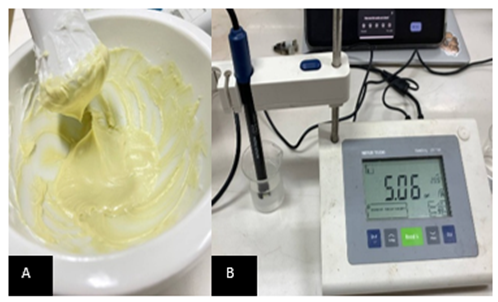
Stability evaluation showed that the cream remained physically stable when stored at temperatures between 20 °C and 40 °C with 75% relative humidity, with no visible phase separation or change in color throughout the testing period. The pH of the cream formulation was found to be 5.06 (Figure 1), which falls within the acceptable range for topical cream skin application. Preliminary users show that the C. Odorata cream provided a soothing sensation when applied on the skin, with noticeable reduction in skin redness and overall improvement in skin comfort.
Table 3. Correlation coefficient (r) indicated the strength and direction of relationship between secondary metabolites and antioxidant activities (FRAP and DPPH). Value close to +1 indicated a strong positive correlation, value close to -1 indicated a strong negative correlation, and value near 0 suggested a weak or no linear relationship.
| Method | TPC | TFC | TCC | TAIC | FRAP | DPPH |
| TPC | 1 | 0.955* (P = 0.012) | 0.635 (P = 0.250) | -0.142 (P = 0.820) | 0.588 (P = 0.297) | 0.415 (P = 0.487) |
| TFC | 0.955* (P = 0.012) | 1 | 0.638 (P = 0.247) | -0.393 (P = 0.512) | 0.376 (P = 0.533) | 0.464 (P = 0.431) |
| TCC | 0.635 (P = 0.250) | 0.638 (P = 0.247) | 1 | 0.186 (P = 0.764) | -0.007 (P = 0.990) | 0.946* (P = 0.015) |
| TAIC | -0.142 (P = 0.820) | -0.393 (P = 0.512) | 0.186 (P = 0.764) | 1 | 0.251 (P = 0.684) | 0.153 (P = 0.806) |
| FRAP | 0.588 (P = 0.297) | 0.375 (P = 0.533) | -0.007 (P = 0.990) | 0.251 (P = 0.684) | 1 | -0.194 (P = 0.754) |
| DPPH | 0.415 (P = 0.487) | 0.464 (P = 0.431) | 0.946* (P = 0.015) | 0.153 (P = 0.806) | -0.194 (P = 0.754) | 1 |
äStatistically significant is noted as P < 0.05.
Correlation Coefficient (r)between Secondary Metabolites and Antioxidant Activities
Table 3 presented the significant positive correlation observed between TPC and TFC (r = 0.955, P < 0.05) suggested that flavonoids constitute a major portion of TPC that was presented in C. odorata since flavonoid is a subclass of phenolic compounds. In Addition, DPPH and TCC(r = 0.946, P < 0.015) suggested that condensed tannin plays a key role in radical scavenging activity. The outcome confirmed that phenolic compounds including flavonoids and tannins were major contributors to antioxidant potential of C. odorata.
Discussion
C. odorata leaves were extracted using ethanol to obtain the crude extraction, which was experimentally evaluated to generate scientific evidence supporting the development of the herbal cream in Cambodia. Ethanol is a well-known solvent to extract plant compounds and is considered safer for human health, requiring fewer toxicological and pharmacokinetic evaluation compare with methanol [17]. Although crude extraction using ethanol may produce lower quantities of compounds than methanol extraction, the resulting herbal cream formulation still provides effective compounds to ensure safety for human application as the natural product.
According to previous study, C. odorata leaves that were extracted with 70% of ethanol too that yield extraction was 15.83%, TPC was 113.15 mg GAE/g, and DPPH was 223.33 ± 9.20 µg/mL [18]. Extensive research has been conducted on the bioactive compounds and antioxidant activities of C.odorata. High value of TPC (1373.75 mg GAE/g extract), TFC (301.09 mg QE/g extract), TCC (1373.75 mg TAE/g extract), and DPPH (13.04 mg/mL) were reported comparing differing form the findings of this study [19]. In Indonesia, TFC value ofC. odorata found was 125.459 ± 0.163 mg/g that differed from results of this research [20]. Moreover, another article found TPC was 182.26 ± 1.99 mg GAE/g, TFC was 128.57 ± 7.63 mg QE/g, DPPH was 32.81 ± 5.26 µg/mL [21]. Furthermore, FRAP assay results were reported in previous studies showed considerable antioxidant activity with ferric-reducing capacities of 90.16 ± 0.76 % and 271.25 µg/mL [22][23]. The relationship between TPC and antioxidant activities that were discussed in many studies above suggesting phenolic compound play the main role in ferric-reducing and radical-scavenging mechanisms of C. odorata.
Frap assay assesses antioxidants ‘electron-reducing ability by converting Fe3+ to Fe2+ while DPPH assay measures their capacity to neutralize free radicals via hydrogen condition [24][25]. Both methods are important because oxidative stress contributes to inflammation by generating reactive oxygen species (ROS) that activate inflammatory mediators [26].
Alkaloid could modulate inflammatory pathways by inhibiting pro-inflammatory mediators such as nitric oxide (NO), prostaglandins, and cytokines which helped reduce redness, swelling, and irritation in tropical application [27][28]. As reported in an earlier publication, TAIC of C. odorata was expressed in percentages value of 8.256% and 5.938% [29]. Due to the limited availability of published data on TAIC of C. odorata, the obtained TAIC value was compared with studies investigating alkaloid in other medicinal plants with established wound-healing activity. Previous study on Vernonia amygdalina demonstrated that TAIC was 9.95 ± 0.41 mg AE/g dry material and Solanum torvum was 6.32 ± 2.3 mg/g in mature fruit, results were higher than C. odorata extraction(4.66 ± 0.01 mg AE/g CE) [30].
Bioactive compounds of C. odorata,particularly flavonoids and phenolic compounds exhibit anti-inflammatory activity by inhibiting medicator such as nitric oxidant (NO), cyclooxygenase (COX), and pro-inflammatory cytokines [31][32]. Following this mechanism, the extraction reduces oxidative stress and modulate inflammatory pathways with supporting their therapeutic potentials in wound healing and management of skin inflammation [33].
The strong positive correlation between TPC and TFC (r = 0.955, P < 0.05) showed that flavonoid was a major subclass of phenolic compound. Phenolic compound was wieldy recognized for antioxidant activity due to their ability to donate hydrogen atoms or electrons to stabilize free radicals through resonance mechanisms [34][35]. This relationship was supported by a study that showed phenolic and flavonoid contents correlate strongly with antioxidant activity in plant extract that indicated flavonoid contribute substantially to phenolic and associated radical-scavenging potential [36]. The strong correlation between DPPH and tannin content (r = 0.946, P < 0.015) revealed tannin was a key contributor to radical scavenging capacity which aligned with recognized ability of tannin to chelate metal ions and directly scavenge relative species [37]. The strong correlation between phenolic compounds and antioxidant activity indicates these compounds are likely the major contributors to the observed radial scavenging capacity [38].
The physical characteristic of C. odoratacream developed in this study, included smooth texture, homogeneity, good stability, rapid absorption, and pleasant scent. The similar finding has been reported on formulation of C. odorata extraction into the antibacterial cream which observed acceptable organoleptic properties, stable pH, and good physical stability over 28 days that indicated the extraction could be effectively incorporated into tropical cream system with desirable formulation attributes [39]. Additionally, another study reported the gel formulations contained C. odorata demonstrated favorable dispersion and acceptable organoleptic after accelerated stability testing, supporting the notion that phytochemical-rich extraction from this plant-maintained stability in semi-solid delivery systems [40].
The pH values of 5.06 presented in cream within the physiologically acceptable range for skin application for minimizing irritation and maintaining skin barrier integrity with stability assessments in C. odorata cream that also had pH values compatible with skin use [39]. Moreover, previous research highlights their bioactive potential of formulation cream has been shown to possess antioxidant and anti-inflammatory activity that indicated therapeutic benefits beyond cosmetic properties [41]. These finding suggest that bioactive compounds in C. odorata plays a synergistic role in enhancing antioxidant potential.
However, formulated cream confirmed acceptable physicochemical stability, the further examination is essential for large-scale production. Factors such as long-term stability, microbial contamination control, and consistency of active compound concentration must be carefully monitored including emulsification processes and preservation system will be required to maintain formulation quality during commercial scale-up and storage [42][43].
As the results of limitations, only ethanol extraction was conducted while other extraction solvents may yield different phytochemical profile firstly. Second, qualification of alkaloid and other bioactive was using spectrophotometry method, which may be less precise than advance chromatographic methods such as HPLC or LC-MS. Third, cream formulation was analyzed only for stability and physicochemical properties while biological efficacy and safety were not tested in vivo or in clinical setting. Further research will include detailed bioactive characterization, evaluation of antioxidant, anti-inflammatory, and antibacterial activities using cellular model, as well as clinical studies to confirm safety and therapeutic effectiveness of formulation to humans.
Conclusion
The outcome of this study presented bioactive compounds which contributed to notable antioxidant activities of C. odorata. The potential benefit of leaves extractionsupported therapeutic profile for anti-inflammatory activity was formulated to be skin irritation application. The herbal cream was accepted with physicochemical properties and stability that its suitability for further pharmacological and clinical evaluation. Overall, C. odorata leaves extraction showed the promising natural candidate for development of safe and effective topical product for skin care and inflammation management. On the other hand, future study will investigate additional experiments to guarantee its safety of formulation to human.
Reference
- T. Lim, E. O. Davis, B. Crudge, V. Roth, and J. A. Glikman. (2022). “Traditional Khmer Medicine and its role in wildlife use in modern-day Cambodia”. J. Ethnobiol. Ethnomed 18: 1–12.
- F. Olawale, K. Olofinsan, and O. Iwaloye. (2021). “Biological activities of Chromolaena odorata: A mechanistic review”. Elsevier B.V. 144:44-57.
- M. Zahara (2019). “Description of Chromolaena odorata L. R.M King and H. Robinson as medicinal plant: A Review”. IOP Conf. Ser. Mater. Sci. Eng. 506:1–6.
- N. A. Aziz. (2020) “The Pharmacological Properties and Medicinal Potential of Chromolaena odorata: A Review”. International Journal of Pharmaceuticals, Nutraceuticals and Cosmetic Science 2: 30–41.
- E. Jumrah. (2025) “Review Article: Phytochemical Screening and Potential Biological Activities of Lahuna Plants (Chromolaena odorata L.)”. HAYYAN JOURNAL 2:58–63.
- A. Sirinthipaporn and W. Jiraungkoorskul. (2017). “Wound healing property review of siam weed, Chromolaena odorata”. Medknow Publications 11:35-28.
- N. D. Huynh Luu et al. “Topical cream based on nanoformulation of Chromolaena odorata extract for accelerating burn wound healing”. J. Drug Deliv. Sci. Technol. 82: 104360.
- M. Peanparkdee, J. Patrawart, and S. Iwamoto, “Physicochemical stability and in vitro bioaccessibility of phenolic compounds and anthocyanins from Thai rice bran extracts,” Food Chem., vol. 329, no. 11, p. 127157, Nov. 2020, doi: 10.1016/j.foodchem.2020.127157.
- M. Sekar and N. S. A. Jalil. (2017). “Formulation and evaluation of novel antibacterial and anti-inflammatory cream containing Muntingia calabura leaves extract”. Asian Journal of Pharmaceutical and Clinical Research 10:376–379.,
- Quality control methods for herbal Materials. World Health Organization, 2011.
- T. Tiranakwit et al. (2023) “Phytochemical Screening on Phenolic, Flavonoid Contents, and Antioxidant Activities of Six Indigenous Plants Used in Traditional Thai Medicine”. International Journal of Molecular Sciences 24:1–20.
- V. So et al. (2023) “Bioactive Compounds, Antioxidant Activities, and HPLC Analysis of Nine Edible Sprouts in Cambodia”. Molecules 28:2874.
- A. A. Elhewehy, A. M. El-Fishawy, R. M. Aly, E. Mohsen, and M. A. A. Fayed. (2026) “Isolation and Quantification of Polyphenolics, Exploration of Antioxidant, Cytotoxicity, and Wound Healing Activities of Pithecellobium dulce (Roxb.) Benth”. Scientific Reports 16:1–18.
- P. Pothirat et al. (2024) “Enhancement of Biological Activities and Phytochemical Compounds of Oryza sativa L. Extract through Probiotic Fermentation”. Natural and Life Sciences Communications 23:1–19.
- N. F. Abdul Rahim, N. Muhammad, N. Abdullah, B. A. Talip, and N. J. S. Dusuki. (2018) “Synergistic Effect of Polyherbal Formulations on DPPH Radical Scavenging Activity”. Journal of Science and Technology 10:121–129.
- S. Mukherjee et al. (2011) “Evaluation of Free-Radical Quenching Properties of Standard Ayurvedic Formulation Vayasthapana Rasayana”. BMC Complementary and Alternative Medicine 11:1–6.
- T. Sangnim et al. (2022) “Development and Evaluation of Liquid Plaster Loaded with Chromolaena odorata Leaf Extract Endowed with Several Beneficial Properties to Wound Healing”. Gels 8:1–22.
- T. Tiranakwit et al. (2023) “Phytochemical Screening on Phenolic, Flavonoid Contents, and Antioxidant Activities of Six Indigenous Plants Used in Traditional Thai Medicine”. International Journal of Molecular Sciences 24:1–20.
- A. Abubakar, H. Yusuf, M. Syukri, R. Nasution, and R. Idroes. (2023) “Chromolaena odorata Linn Leaf Extract – Geothermal versus Nongeothermal: Phytochemical, Antioxidant, and Cytotoxicity Screenings”. Journal of Advanced Pharmaceutical Technology & Research 14:332–337.
- I. Solihah, H. Herlina, I. Munawwaroh, and R. S. P. Rasyid. (2020) “In vivo study of the antioxidant test of ethanolic extract of Chromolaena odorata Linn. Leaves.” MEDISAINS 18:86–92.
- A. Budha Magar, D. Shrestha, S. Pakka, and K. R. Sharma. (2023) “Phytochemistry, Biological, and Toxicity Study on Aqueous and Methanol Extracts of Chromolaena odorata.” Scientific World Journal 2023:1–11.
- I. L. Eze, F. A. Onyegbule, C. O. Ezugwu, J. V. Chibuzor, and O. M. Aziakpono. (2024) “Phytochemical and Antioxidant Evaluations of Chromolaena odorata and Huntaria umbellata,” J. Pharm. Res. Int. 36:213–224.
- A. O. Ogunniran, O. S. Dauda, O. V. Adeleke, M. M. Omowaye, B. I. Okon, and F. A. Daramola. (2025) “Assessment of the Nutritional, Antioxidant and Antimicrobial Properties of Chromolaena odorata Leaves.” Biotechnology Journal International 29:1–14.
- İ. Gulcin. (2025) “Antioxidants: a comprehensive review.” Springer Science and Business Media Deutschland GmbH 99:1893-1997.
- U. B. Okeke, P. Igbinaduwa, J. A. Aladesanmi, V. Mzozoyana, and I. O. Kehinde. (2025) “GCMS-Based Phytochemical Profiling, Antioxidant and Anti-Inflammatory Activity of Triterpenoid-Rich Hydroethanolic Extract and Fractions of Ficus Sur (Forrsk) Stem Bark” Natural and Life Sciences Communications 25:1-60.
- C. F. Manful, E. Fordjour, E. Ikumoinein, Lord Abbey, and R. Thomas. (2025) “Therapeutic Strategies Targeting Oxidative Stress and Inflammation: A Narrative Review.” Multidisciplinary Digital Publishing Institute (MDPI) 5:1-49
- B. Aryal et al. (2022) “Potential Therapeutic Applications of Plant-Derived Alkaloids against Inflammatory and Neurodegenerative Diseases”. BioMed Research International 2022:7299778.
- A. Rajput, R. Sharma, and R. Bharti. (2022) “Pharmacological Activities and Toxicities of Alkaloids on Human Health”. Materials Today: Proceedings 48:1407–1415.
- P. Olivia Nayaken, A. Rakhman Hakim, and T. Alawiyah. (2023) “Determination of Total Alkaloid Content of Kirinyuh Leaf Extract (Chromolaena odorata) Based on Different Extraction Methods”. Indonesian Journal of Pharmacy and Natural Product 6:194–200.
- N. Thanh Tuan, P. Thi My Huyen, N. Thi Quyen Tran, D. Thi Tuyet Mai, and H. Thi Ngoc Nhon. (2023) “Alkaloids Extraction from Vernonia amygdalina Del. and Evaluate the Reducing Power Activity of the Obtained Extract”. Journal of Science Technology and Food 23:3–13.
- A. S. D. Cahyo, S. Oktavia, and I. Ifora. (2021) “Anti-Inflammatory and Analgesic Potential of Chromolaena odorata: A Review.” International Journal of Pharmaceutical Sciences and Medicine 6:8–16.
- T. R. Teuku Husni, D. Darmawi, A. Azwar, and K. F. Jamil. (2023) “Bioactive phytoconstituents of ethanolic extract from Chromolaena odorata leaves interact with vascular endothelial growth factor and cyclooxygenase-2: A molecular docking study.” J. Adv. Pharm. Technol. Res. 14:29–33.
- V. M. Trang, N. T. Son, N. D. Luyen, and P. M. Giang. (2025) “Essential Oils From Chromolaena odorata (L.) R. M. King and H. Robinson Stem Barks and Leaves: Chemical Analysis, Biological Activity and In Silico Approach.” Chem. Biodivers. 22: e202500091.
- M. Zahra, H. Abrahamse, and B. P. George. (2014) “Flavonoids: Antioxidant Powerhouses and Their Role in Nanomedicine,” Antioxidants 13:1–26.
- T. G. Bas. (2026) “Dietary Polyphenols (Flavonoids) Derived from Plants for Use in Therapeutic Health: Antioxidant Performance, ROS, Molecular Mechanisms, and Bioavailability Limitations”. International Journal of Molecular Sciences 27:1–55.
- Y. M. Muflihah, G. Gollavelli, and Y. C. Ling. (2021) “Correlation study of antioxidant activity with phenolic and flavonoid compounds in 12 indonesian indigenous herbs” Antioxidants 10:1–15.
- L. Zhang, Q. Guan, J. Jiang, and M. S. Khan. (2023) “Tannin Complexation with Metal Ions and Its Implication on Human Health, Environment and Industry: An Overview”. International Journal of Biological Macromolecules 253:127485.
- J. Jung et al. (2023) “Antioxidative Impact of Phenolics-Loaded Nanocarriers on Cytoskeletal Network Remodeling of Invasive Cancer Cells.” ACS Appl. Mater. Interfaces 15:34462–34474.
- K. Vijayaraghavan, J. Rajkumar, S. N. A. Bukhari, B. Al-Sayed, and M. A. Seyed. (2017) “Chromolaena odorata: A Neglected Weed with a Wide Spectrum of Pharmacological Activities (Review)”. Molecular Medicine Reports 15:1007–1016.
- Q. A. Z. M. Zamram, H. F. Mohsin, M. Mohamad, N. A. M. Nor Hazalin, and K. A. Hamid. (2022) “Physical Characterisation and Stability Study of Formulated Chromolaena odorata Gel”. Current Drug Delivery 19:479–490.
- S. Ps et al. (2023) “Evaluation of Antioxidant and Anti-Inflammatory Activity of Formulated Herbal Cream”. International Journal of Pharmaceutical Research and Applications 8:404–411.
- N. Halla et al. (2018) “Cosmetics preservation: A review on present strategies” MDPI AG. 23:1-41.
- P. S. Chow et al. (2024) “The Effect of Process Parameters on the Microstructure, Stability, and Sensorial Properties of an Emulsion Cream Formulation.” Pharmaceutics 16:1-21.