An Analysis on Development of cultural cooperation between ASEAN and
Korea as global cultural hubs
Yoomi Kim*
Citation: Kim Y (2025) An Analysis on Development of cultural cooperation between ASEAN and Korea as global cultural hubs. Educational Development in Various Fields: EDIVF-146.
DOI: 10.37722/JAMBE.2025204
Introduction:
With ASEAN’s strategic importance growing in an era of global uncertainty, the Korean government is increasing engagement with ASEAN countries. Korea and ASEAN are strengthening cooperation in the cultural and artistic fields through projects such as the Cultural Innovation Forum and the Korea-ASEAN Cultural Innovation Project (Ministry of Culture, Sports and Tourism, 2025). In addition, the ASEAN-Korea Centre and the ASEAN Culture House are promoting various cultural cooperation projects with the goals of promoting cultural exchange, developing the cultural industry, and enhancing cultural diversity (ASEAN-Korea Centre, 2025). This study proposes effective measures for establishing a cultural hub to strengthen transnational cooperation between ASEAN and Korea. Previous research has confirmed that ASEAN and Korean Asian cultures share a similar identity and a history of conflict and integration (Hong, 2015; Moon, et. al., 2020; Kim, 2006). In particular, political-diplomatic, humanities-sociological approaches have confirmed the cultural diversity between Korea and ASEAN. However, these humanities-sociological approaches have limited policy implications. Therefore, this study aims to develop Asian cultural indicators as a global index to establish a hub culture for more concrete cooperation and communication, and to measure the economic impact of Korea-ASEAN cultural exchanges, thereby suggesting directions for future research. To foster ASEAN’s identity, a key focus of the ASEAN Socio-Cultural Community (ASCC) Blueprint 2025 and the ASEAN Strategic Plan for Culture and Arts 2016-2025, this study analyze objective indicators to foster a global image. Categorizing the various elements of this culture in a distinctive way is expected to further enhance the value of ASEAN culture. Furthermore, with the acceleration of socio-cultural exchange in between Korea and ASEAN, this study conduct research on the economic impact on trade of cultural goods, focusing on the ASEAN countries and Korea.

Watch the Article in Motion
Methodology
Korea established the Comprehensive Strategic Partnership (CSP), the highest-level partnership at the 26th Korea-ASEAN Summit in 2025. To advance the cultural cooperation between ASEAN and Korea based on the goal of Korean government; this study proposes the following research methodology to develop cultural indicators. Based on the expert interview technique, Focused Group Interview (FGI), variables are derived to survey the general cultural consumer’s perception of ASEAN culture. To verify the validity of the measurement indicators derived through FGI, statistical analysis including exploratory factor analysis will be conducted. And, the economic effects of the derived socio-cultural factors are analyzed with a focus on cultural cooperation programs between Korea and ASEAN.
FGI technique
Focus group interviews (FGIs) select experts with knowledge of the research area and collect data generated through group social interactions (Richardson & Rabiee, 2001). The type and scope of this data is more in-depth than that obtained through one-on-one interviews (Thomas et al., 1995). Krueger (1994) believes rich data can only be generated if individuals in the group are prepared to engage fully in the discussion and, for this reason, advocates the use of a homogenous group. Based on the topic under investigation Krueger (1994) suggests that participants should share similar characteristics: gender group, age-range, ethnic and social class background. According to this perspective, this study conducts interviews with experts of ASEAN area studies in Korea.
Factor analysis
Factor analysis is a technique that analyzes the interrelationships (co-variances or standardized correlation coefficients) between measurement variables, extracts common factors, and reduces the number of variables that can distinguish all measurement variables while minimizing information loss (Hair et., al, 2006). Therefore, factor analysis can reduce a large amount of information (multiple measurement variables) into a few core factors, enhancing understanding and enabling further analysis (correlation or causality).
Socio-cultural effect
This study proposes empirical research to determine the effectiveness of this study and derive policy implications. To this end, we will preemptively apply input-output analysis to quantify economic spillover effects (Miller and Blair, 1985). Using I-O tables, this study estimate 1) production-induced effects, 2) value-added inducements, and 3) forward and backward linkage effects. The economic impact of cultural cooperation on the economies of both countries are estimated the production-inducing effect and this analysis estimates whether the cultural industry contributes to national income based on the result from analyzing the added value effect. By identifying forward and backward linkage effects, it also is estimated the economic impact of cultural cooperation industries between the ASEAN-Korea on other industries. This study examines the economic impact of ASEAN-Korea cultural exchange and establishes a foundation for future research.
Production Inducement Effect
X = (I-Ad)-1Yd
Value-Added Inducement Effect
V = ÂV(I-Ad)-1Yd
Forward and Backward Linkage Effect
∑_i^n▒Lij ∑_(j=1)^n▒Lij
Analysis
According to ‘Framework for the ASEAN-ROK Cooperation Fund 2021-2025’, the priority sectors of culture and tourism included 1) two-way cultural exchange; 2) the development of cultural and creative industries and MSMEs; 3) active cooperation in tourism and sports; 4) multicultural inclusion; 5) people-to people exchange initiative by utilizing virtual and digital technologies. To present a new framework for cultural cooperation and develop promising cultural industries, this paper first present classification of cultural cooperation industries between Korea and ASEAN. This study analyzes the composition of cultural cooperation fields to develop to establish accurate indicators for the cultural industry. The 2009 ASCC(ASEAN Socio-Cultural Community) Blueprint stated that the primary objective of the socio-cultural community was to “build a caring and sharing society that realizes the well-being and quality of life of its citizens foster a shared identity, and contribute to the realization of a people-centered and socially responsible ASEAN community that achieves solidarity and unity among ASEAN peoples and nations.” It also proposed improving the quality of life, environmentally friendly and sustainable development, mutual understanding, respect for culture and diversity, and narrowing the development gap as core values of the ASCC. Based on this, the six key areas for promoting the ASCC (6 Characters) were proposed: ① Human Development, ② Social Welfare and Protection, ③ Social Justice and Rights, ④ Ensuring Environmental Sustainability, ⑤ Building ASEAN Identity, and ⑥ Narrowing the Development Gap. A number of implementation tasks were proposed.
First, this paper focuses on Building ASEAN identity, one of the core areas presented in the ASCC blueprint, and presents cultural indicators to reveal ASEAN identity. Indicating ASEAN culture differentiates ASEAN’s unique culture from other cultures and enhances its influence and value. This paper selected range of areas, including: Culture and Arts, Information and Media, Education, Youth, Sports from the ASCC blueprint. Second, this paper is considered key issues recognized and discussed as common challenges in the international community. The United Nations, primarily through its specialized agency UNESCO, fosters cultural cooperation across several specific areas. These areas include: Cultural Heritage Preservation, Promotion of Creative Industries, Diversity of Cultural Expressions, Culture and Sustainable Development, Intercultural Dialogue and Mutual Understanding, Policy and Capacity Building, Combating Illicit Trafficking (UNESCO, 2012). Third, according to Fact sheet from Ministry of Foreign Affair in Korea (2021), the ASEAN-Korea cultural cooperation area is a collaboration focused on fostering mutual understanding through exchanges in arts, culture, film, music, and heritage (MoFA, 2021).
| ASCC | UNESCO | ASEAN-Korea cultural cooperation |
| Culture and Arts | Cultural Heritage Preservation | exchanges in arts |
| Information and Media | Promotion of Creative Industries | exchanges in culture |
| Education | Diversity of Cultural Expressions | exchanges in film |
| Youth | Culture and Sustainable Development | exchanges in music |
| Sports | Intercultural Dialogue and Mutual Understanding | heritage |
| Policy and Capacity Building | ||
| Combating Illicit Trafficking |
Based on this, this paper has selected the core areas of cultural cooperation between Korea and ASEAN, including publication, cartoon, music, game, film, animation, broadcasting, character, IT industries (Figure 1).
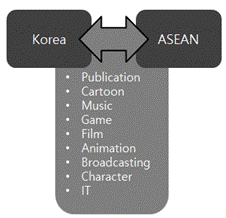
According to Korean Statistical Information Service (2025), the volume of cultural goods trade between Korean and ASEAN is on the rise. As of 2023, the export and import status of the key cultural cooperation industries designated in this paper is as shown in Table 2.
| Areas | Export | Import |
| Publication | 34,295 | 10,879 |
| Cartoon | 24,483 | 0 |
| Music | 157,753 | 531 |
| Game | 1,613,759 | 6,820 |
| Film | 9,689 | 8 |
| Animation | 6,302 | 782 |
| Broadcasting | 27,794 | 191 |
| Character | 93,524 | 20,408 |
| IT | 270,163 | 20,408 |
Result of research
Factor Analysis
First, this study analyzed the correlations between each variable. Exploratory factor analysis, which utilizes statistical software, assumes that all constructs are related to all measurement variables. Therefore, factor analysis was conducted using Google Colab. The factor analysis revealed a significant disparity in variable contribution. The single extracted factor was overwhelmingly dominated by ‘Export’ with a loading of approximately 489,571, while ‘Import’ had a substantially smaller loading of around 901. This indicated that the factorwas largely driven by the ‘Export’ variable due to its much larger scale. This means that Korean cultural products have a greater impact on ASEAN countries in the cultural sector.
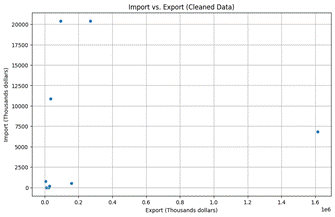
After applying Standard Scaler to the ‘Export’ and ‘Import’ variables, it showed nearly identical factor loadings of approximately 0.3109. This demonstrates that scaling successfully equalized the contribution of both variables to the single extracted factor. In this case, the single factor for scaled data now more accurately represents a general “trade activity” influenced equally by both variables of export and import, rather than being skewed by a single dominant variable. This is the result when the total export and import amounts are included in the variables, because the trade volume of cultural goods is very small compared to the total export and import amounts. Therefore, when total export and import values were removed from the variables and factor analysis was performed, the number of factors varied between four and five (Figure 2). This demonstrates that cultural cooperation between Korea and ASEAN cannot be narrowed down to one or two areas, and that diverse collaboration is necessary.
I-O table Analysis
Production inducement effect
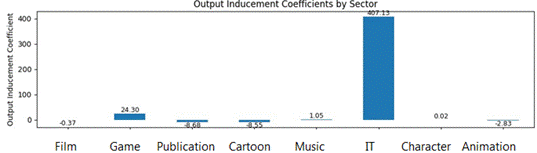
Second, Using ADB’s Multi-regional Input-out table, this research estimated the production inducement effect of cultural cooperation between Korea and ASEAN countries. The analysis of production inducement effects reveals which sectors and regions experience the largest economic ripple effects from changes in final demand. The output inducement coefficients vary significantly across sectors. For instance, ‘IT industry’ has a coefficient of approximately 407.13, ‘Game industry’ is around 24.30, ‘Music’ is about 1.05, and ‘Character’ is approximately 0.02. Notably, sectors such as ‘Film’, ‘Animation’, ‘Cartoon’, and ‘publication’ show negative coefficients (Figure 3). The visualization clearly highlights ‘Game’ as a dominant sector in terms of generating economy-wide output from increased final demand. It also visually confirms that most other sectors have relatively much smaller positive inducement effects, while a few sectors stand out with negative effects, indicating a need for careful analysis of their economic structure. The ‘IT’ sector is a critical economic driver; policies supporting its growth could lead to substantial multiplier effects across the economy.
Value added effect
The analysis revealed that all sectors exhibit a value-added inducement coefficient of approximately 1.0. This analysis suggests that for every 1 unit increase in final demand in any given sector, the overall economy generates 1 unit of value added, consistent with the theoretical accounting balance of the Leontief input-output model. The analysis revealed that all sectors exhibit a value-added inducement coefficient of approximately 1.0. However, the intermediate calculation of value-added coefficients showed unusual negative values for most sectors (e.g., publication: -2.99, cartoon: -19.69), which warrants further investigation. In a standard economic interpretation, these coefficients should typically be between 0 and 1, representing the proportion of output that is value-added. Despite the negative value-added coefficients, the subsequent calculation of value-added inducement coefficients showed a remarkably uniform result, with all sectors having a coefficient of approximately 1.0. The bar chart visualization clearly depicted that all sectors contributed to a value-added inducement coefficient of 1.0, showing a flat graph across all sectors (Figure 4).
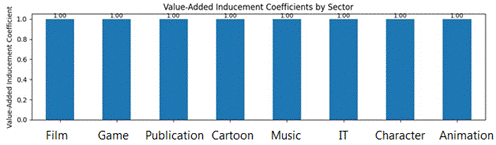
The analysis noted that the uniform 1.0 value-added inducement coefficient aligns with the theoretical expectation of the Leontief inverse properties and the accounting balance principle of input-output models, where a 1-unit increase in final demand ultimately translates to a 1 unit increase in total value added across the economy.
Forward linkage effect
This research analyzes the forward linkage coefficients for each sector by calculating the row sums of the Leontief inverse matrix (leontief_inverse). These coefficients indicate how much a sector’s production influences (or is sensitive to) the production activities of other sectors. Then, visualize these coefficients using a bar chart with appropriate labels and title, and provide a summary and insights based on the visualization (Figure 5).
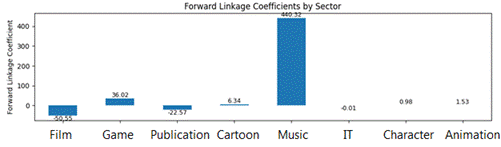
‘Music’ industry exhibited an exceptionally high forward linkage coefficient of approximately 440.32, indicating its strong simulative effect on other industries. The high forward effect in the music sector appears to be due to the popularity of K-pop. In 2023 report from Korean Foundation for International Cultural Exchange, Indonesia recorded 7.4 billion on-demand streams, and the Philippines had 4.2 billion. And Indonesia and Malaysia had some of the highest percentages of people (88.6% and 89.7% respectively) who reported experiencing K-pop (KOFICE, 2024). Additionally, it has been confirmed that the influence of K-pop has had an economic effect on the development of related industries, including the purchase of Korean clothing and cosmetics (Jeon∙Kim, 2025).
Other sectors with notable positive forward linkage effects include ‘Game’ industry (approx. 36.02), ‘Cartoon’ (approx. 6.34), ‘Character’ (approx. 0.98), and ‘Animation’ (approx. 1.53). Negative forward linkage coefficients were observed for ‘Film’, ‘Publication’, and ‘IT’’. These negative values suggest that increased production in these sectors might inhibit other sectors’ output or that their output is primarily for final consumption rather than intermediate inputs.
Backward linkage effect
This analysis derives the backward linkage coefficients for each sector by calculating the column sums of the Leontief inverse matrix (leontief_inverse). These coefficients indicate how much a one-unit increase in production activity in a sector triggers the input of intermediate goods from other sectors (i.e., how sensitive it is to other sectors). The backward linkage effects coefficients have been calculated and visualized. Each sector’s backward linkage effect is as Figure 6.
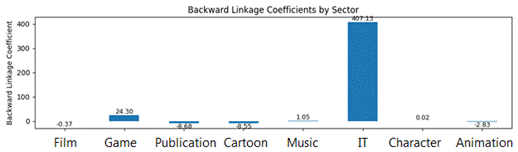
The ‘IT’ sector exhibits the highest backward linkage effect, at approximately 407.13. This indicates that an increase in production in this sector strongly stimulates intermediate goods demand from other industries, making it a significant driver for backward industrial development. As convergence using IT technology rapidly advances across all industries, the very nature of IT is rapidly changing, and IT is establishing itself as a fundamental technology that enhances added value across all industries. the IT industry has vertically integrated IT services with downstream industries such as devices and software. However, the IT industry is currently expanding its scope by converging with downstream NT sectors, applying them to upstream industries such as other industries, and horizontally integrating with other industries.
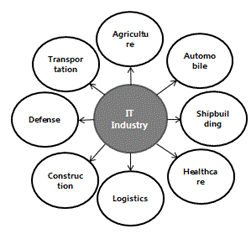
Figure 7: Supply-demand relationships between the IT industry and traditional industries
Other sectors with positive backward linkage effects include ‘Game’ Industry (approximately 24.30), ‘Music’ (approximately 1.05), and ‘Character’ (approximately 0.02). These sectors, when increasing production, also promote growth in their respective intermediate goods supply industries. Negative backward linkage effects were observed in sectors such as ‘Hotels and restaurants’ (approximately -0.37), ‘Post and telecommunications’ (approximately -8.68), ‘Financial intermediation’ (approximately -8.55), and ‘Other community, social, and personal services’ (approximately -0.20). This suggests these sectors may have a low reliance on intermediate inputs from other domestic industries, possibly due to self-production, direct service provision to final consumers, or a high dependency on imports.
Conclusion
The expected impact of this study lies in the advancement, globalization, and popularization of ASEAN culture. As previously stated in the research objectives, prior research has demonstrated that ASEAN has long established its own unique cultural concepts and characteristics. For these reason, empirical efforts to universalize these concepts are necessary. This paper proposes ways for the convergence of cultures between Korea and ASEAN through cultural exchange to drive global culture.
First, key areas of cultural cooperation between Korea and ASEAN were identified for developing a global cultural index. Factor analysis revealed that collaboration is needed across diverse sectors, including broadcasting, music, IT, and character design. In other words, because the clusters of variables are difficult to group into one or two, Korea and ASEAN must pursue direct cooperation and a multifaceted approach across sectors.
Second, The IT industry showed the highest coefficients in terms of production-induced effects and backward linkage effects, suggesting that human and technological exchanges are necessary for IT-related cultural cooperation. ‘IT’ industry stands out as a crucial sector due to its high economic effect, implying that policies promoting its growth could have significant ripple effects across the economy. On the other hand, the ‘Music’ industry was found to have a high forward effect, but ASEAN’s exports to Korea were not high compared to Korea’s exports to ASEAN, suggesting that cooperation in areas such as promotion for mutual synergy effects and transfer of know-how in the entertainment industry is necessary. As for the value-added industry, it appears that all value-added effects are present, so it is necessary to calculate the exact value-added inducement amount in the future and seek ways to further increase the ripple effect.
However, further investigation is required for sectors with negative economic effect to understand the underlying economic mechanisms, data limitations, or model assumptions that might lead to such results. And in spite of high economic impact on IT and Music industries compare to other cultural industries, current cultural cooperation policies between Korea and ASEAN focus solely on people-to-people exchanges and events. Therefore, it suggests that there is a need to combine existing economic cooperation and human exchanges, and that inter-ministerial cooperation in each country is also necessary. This study provides a basic data for cultural cooperation between Korea and ASEAN, and it is expected that through follow-up research, cooperation between ASEAN and Korea is contributed to the growth of Asian culture.
Reference
- ASEAN-Korea Centre. (2025). Press releases. Retrieved from https://www.aseankorea.org/eng
- Hair, J.F.Jr., Black, W.C., Babin, B.J., Anderson, R.E., & Tatham, R.E. (2006). Multivariate data Analysis(6th ed.). NJ: Pearson Prentice Hall.
- KOFICE. (2024). 2023 Overseas Hallyu Survey. Korean Foundation for International cultural Exchange.
- Kim, M-J. (2006). A Study on Invigorating Cultural Cooperation between ASEAN and Korea. East Asian Studies, 51: 71-104.
- Kruger, R.A. (1994). Focus Groups: A Practical Guide for Applied Research (2nd ed.). CA: Sage
- Miller R.E. and Blair P.D. (1985). Input-output analysis: foundations and extensions. Prentice-Hall.
- Ministry of Culture, Sports and Tourism. 2025. Korea and ASEAN Expand Cooperation Through Future Innovation Cultural Exchanges, press release, 4th Nov.
- MoFA. (2021). Fact Sheet: ROK-ASEAN Cooperation under the New Southern Policy. Ministry of Foreign Affair in Korea
- Richardson, C. A., & Rabiee, F. (2001). A question of access: an exploration of the factors that influence the health of young males aged 15 to 19 living in Corby and their use of health care services. Health education journal, 60(1), 3-16.
- Thomas L, MacMillan J, McColl E, Hale C & Bond S. (1995). Comparison of focus group and individual interview methodology in examining patient satisfaction with nursing care. Social Sciences in Health 1, 206–219.
- UNESCO. (2012). UN System Task Team on the Post-2015 UN Development Agenda.
- Mun, J-Y, Na, S-K, Lee, J-H, Lee, S-H, Kim, E-M. (2019). Cooperation Plans between the ASEAN Socio-Cultural Community and Korea in Different Sectors. KIEP research report, 19-07. Seoul: KIEP.
- Lee, K-H, An, C-M, Park, K-M. (2008). Analysis of the Convergence of Traditional and IT Industries. Electronics and Telecommunication Trends, 23(2).
- Jeon, J-K and Kim, S-N. (2025). 2024 Study on the Economic Ripple Effects of the Korean Wave in 2024. Korea Foundation.
- Hong, S-J. (2015). Suggestions for Activating Social and Cultural Exchange and Cooperation between Korea and Southeast Asia: In celebration of the 2014 Korea-ASEAN Special Summit. JPI Policy Forum, 2014-17/18: 3-6.