Effect of Combined Vaccination on Survival Rate of Nile Tilapia (Oreochromis Niloticus) Immunized Against Streptococcus Agalactiae Serotype Ib, Streptococcus Iniae, And Isknv Vaccine
Talita Morgenstern*, Leonardo Cericato
*Corresponding author: Talita Morgenstern, MSD Animal Health, São Paulo, SP, Brazil;
Email: talita.morgenstern@msd.com
DOI: 10.37722/JAMBE.2026202
Abstract
Intensive tilapia farming is affected by bacterial and viral diseases, with different regions and production systems presenting distinct epidemiological challenges. Streptococcosis remains one of the most relevant bacterial diseases in global tilapia production, while infectious spleen and kidney necrosis virus (ISKNV) has emerged as a pathogen of increasing importance due to its immunosuppressive effects and association with secondary bacterial infections. Vaccination represents a key strategy for disease prevention and production sustainability. This study evaluated the effect of combined immunization with AQUAVAC® Strep Sa-Si and AQUAVAC® Irido V on the survival rate of Nile tilapia reared under natural field conditions in the Ilha Solteira Reservoir, São Paulo, Brazil. The combined vaccination group demonstrated a 23.39 percentage-point increase in survival compared to fish vaccinated only against Streptococcus spp. These findings indicate improved survival performance associated with concurrent bacterial and viral immunization under commercial farming conditions.
Keywords
Nile tilapia; vaccination; streptococcosis; ISKNV; survival; health.
Introduction
Tilapia farming represents one of the fastest-growing sectors within global aquaculture, with Nile tilapia (Oreochromis niloticus) being the main species cultivated in Brazil and of great economic and social relevance (FAO, 2023). The country ranks among the world’s largest producers, and the expansion of the activity is directly linked to the species’ high adaptability, good zootechnical performance, and acceptance in the consumer market (PEIXE BR, 2025).
However, bacterial and viral infectious diseases constitute the main obstacles to the sector’s sustainability, resulting in significant production losses and health-related costs. Among these diseases, streptococcosis stands out, caused mainly by Streptococcus agalactiae (serotypes Ia, Ib, and III) and Streptococcus iniae, agents widely distributed in tropical and subtropical regions, responsible for recurrent outbreaks and high mortality rates in tilapia. These pathogens are opportunistic and especially affect fish under thermal stress or high stocking density, compromising immunity and zootechnical performance (Assis et al., 2017; Shoemaker et al., 2017).
In recent years, a new health challenge has emerged for tilapia farming: infectious spleen and kidney necrosis virus (ISKNV), belonging to the genus Megalocytivirus (family Iridoviridae). Initially described in ornamental and marine species, ISKNV began to affect farmed tilapia, becoming an emerging pathogen of global importance (Wang et al., 2021; He et al., 2020). This virus shows tropism for hematopoietic and lymphoid organs, causing severe tissue degeneration, systemic immunosuppression and, frequently, mortalities above 80% in acute infections. The immunosuppressive capacity of ISKNV favors the occurrence of secondary bacterial infections, including Streptococcus agalactiae, amplifying the economic and health impacts in intensive fish farms (Dong et al., 2015; Ellis, 2001).
Watch the Article in Motion
Authors:

Talita Morgenstern

Leonardo Cericato
In this context, vaccination has been consolidated as the most effective and sustainable prophylactic tool for controlling these diseases, providing active immunity, reduction in antimicrobial use, and better productive performance (Adams, 2019). Among the available strategies, inactivated vaccines stand out for their safety and stability, being widely used against both bacterial (Streptococcus spp.) and viral (ISKNV) agents (He et al., 2020; Dong et al., 2015). The efficacy of these vaccines depends on factors such as antigenic formulation, type of adjuvant, and emulsion quality, which influence the controlled release of antigens and the duration of the immune response (Burakova et al., 2018; Mutoloki & Evensen, 2020).
Considering the need for integrated solutions for the control of multiple pathogens in farmed tilapia, the present study aimed to evaluate the effect of the combination of AQUAVAC® Strep Sa-Si and AQUAVAC® Irido V vaccines on the survival rate of Nile tilapia under field conditions, analyzing the combined immunological efficacy against bacterial (Streptococcus spp.) and viral (ISKNV) in an intensive farming environment.
Although vaccines against Streptococcus spp. and ISKNV have been individually evaluated in experimental and field settings, commercial-scale data assessing their concurrent administration under natural farming exposure remain limited. Given the interaction between ISKNV-induced immunosuppression and secondary streptococcal infections, evaluating a combined immunization strategy under real production conditions represents an important contribution to integrated disease management. Therefore, this study provides field-based survival data generated at commercial scale, offering novel evidence regarding the practical impact of simultaneous bacterial and viral vaccination in Nile tilapia.
Methods
The trial was initially conducted in the municipality of Paranaíba, State of Mato Grosso do Sul, Brazil, in a commercial Nile tilapia (Oreochromis niloticus) farming unit maintained in excavated ponds with no history of infection by Streptococcus agalactiae serotype Ib, S. iniae and infectious spleen and kidney necrosis virus (ISKNV).
During this phase, the fish were maintained under controlled conditions of management, stocking density, and feeding, ensuring absence of prior exposure to these pathogens. Clinically healthy juveniles were distributed into two experimental groups, according to the following table:
| Control | Treatment | |
| Vaccines | AQUAVAC® Strep Sa-Si | AQUAVAC® Strep Sa-Si + AQUAVAC® Irido V |
| Pathogen description | Bivalent inactivated vaccine against Streptococcus agalactiae serotype Ib and Streptococcus iniae | Bivalent inactivated vaccine against Streptococcus agalactiae serotype Ib and Streptococcus iniae Inactivated vaccine against ISKNV virus (Infectious Spleen and Kidney Necrosis Virus). |
Table 1: Description of the immunization program for the control and treatment groups.
Prior to vaccination, fish were subjected to a 24-hour fasting period to reduce handling stress and minimize the risk of regurgitation or coelomic contamination during the procedure. At the beginning of vaccination, animals were anesthetized by immersion using eugenol, prepared at a concentration of 10 mL of eugenol diluted in 90 mL of ethanol and applied to 200 L of water. Fish were maintained under anesthesia for a maximum period of 40 minutes, sufficient to ensure safe handling and accurate vaccine administration. Following vaccination, animals were promptly returned to their original rearing tanks and monitored until full recovery of normal swimming behavior.
Vaccination was performed intraperitoneally, at celomic cavity level, between pectoral fins, using a dose of 0.05 mL of each vaccine per animal, according to the manufacturer’s recommended protocol. The fish had average weights of 31 g (control group) and 17.5 g (treatment group) at the time of vaccination. This difference resulted from operational adjustments in farm management, since the batches were immunized on the same day and were animals from the same batch. It should be noted that such weight divergence does not compromise the validity of the results, as both groups were within the recommended weight range for primary immunization, and the immunological performance of inactivated vaccines is not significantly influenced by small variations in initial biomass, as reported in previous studies with tilapia (Adams, 2019; He et al., 2020).
After the post-vaccination rest period, the fish were transferred to cage nets installed in the Ilha Solteira Reservoir (São Paulo, Brazil), a farming unit with a history of natural ISKNV infection. Fish were stocked in cage nets at a density of approximately 65 kg of fish per m³. A total of 23,883 animals were used across both treatments. Both groups were exposed to the same environmental, management, and feeding conditions, ensuring comparability between treatments.
Fish were distributed into cage nets according to standard farm operational procedures. Each treatment group was allocated into multiple cage units operating under identical management and environmental conditions within the same reservoir area. Cage nets were considered production units rather than strictly controlled laboratory replicates, reflecting commercial-scale farming reality. Allocation was performed to maintain comparable stocking density and biomass distribution between treatments. The total number of fish per treatment was defined according to commercial production scale, and survival analysis was interpreted at the treatment group level.
During the pre-fattening phase, the animals remained under observation for a cultivation period of 90 days, until reaching an average weight of approximately 300 g. Fish were fed balanced commercial feed containing 36% crude protein, appropriate for this production stage, and were fed approximately four times per day. Water physicochemical parameters, including temperature and dissolved oxygen, were monitored daily to adjust feeding tables and ensure optimal rearing conditions. Throughout the experimental period, dead fish were collected and recorded daily.
The survival rate was determined by individual counting of live fish at harvest time, in relation to the initial total number of individuals per group. Data analysis was performed descriptively, comparing survival proportions between the control group and the treated group.
Results
At the beginning of the experimental period, a total of 23,883 fish were allocated to the study, of which 10,105 belonged to the vaccinated group and 13,778 to the control group. At harvest, the vaccinated group presented an estimated 9,600 surviving fish, corresponding to a survival rate of 95.29%, whereas the control group presented approximately 9,782 surviving fish, corresponding to a survival rate of 71.90%. This represents an absolute difference of 23.39 percentage points in survival between treatments.
Survival was calculated based on the proportion of live fish at harvest relative to the initial number stocked per treatment. Although individual fish were counted to determine total survival, experimental units consisted of replicated cage nets, and survival estimates were interpreted at the group level. Comparisons between survival proportions were performed using a chi-square (χ²) test, and 95% confidence intervals were estimated to describe variability. Given the production-scale nature of the trial, statistical analyses were considered supportive and descriptive rather than strictly inferential.
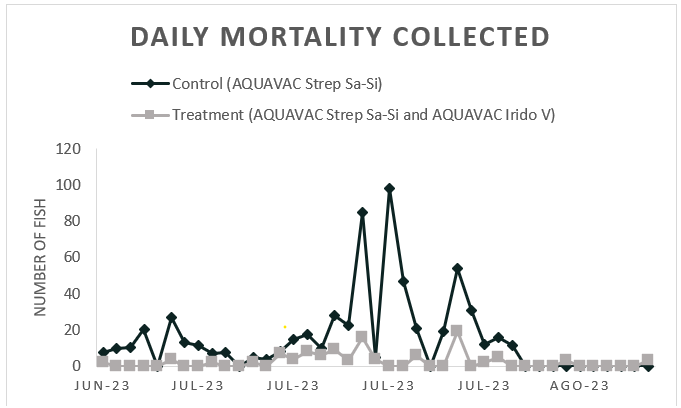
Throughout the cultivation period, mortality was recorded daily. No systematic losses due to escapes, predation, or handling-related discards were observed. All mortalities, regardless of cause, were included in survival calculations, as they reflect real commercial farming conditions. The control group exhibited pronounced mortality peaks coinciding with periods of thermal variation, whereas the vaccinated group maintained greater survival stability during the 90-day cultivation period.
| Group | Vaccination | Survival rate (%) |
| Control | AQUAVAC® Strep Sa-Si | 71.90 |
| Treatment | AQUAVAC® Strep Sa-Si + AQUAVAC® Irido V | 95.29 |
Table 2. Survival rate of control and treatment groups under field conditions.
Discussion
At the end of the experimental period, a survival rate of 71.90% was observed in the control group and 95.29% in the treatment group, representing an increase of 23.39 percentage points in favor of combined vaccination with AQUAVAC® Strep Sa-Si and AQUAVAC® Irido V.
This significant increase in survival supports the protective effect of combined immunization, both against Streptococcus spp. and against natural exposure to ISKNV virus.
Throughout the cultivation period, significant thermal variations were recorded, which acted as environmental stress factors. Such variations coincided with mortality peaks in the control group, indicating a possible trigger for viral replication and clinical expression of ISKNV. In contrast, the treatment group-maintained population stability and low mortality, even during periods of more intense thermal oscillation.
These findings suggest that combined vaccination contributed to greater immunological response and lower susceptibility to thermal stress, ensuring effective protection under natural challenge conditions.
The results obtained demonstrate that the association between AQUAVAC® Strep Sa-Si and AQUAVAC® Irido V promoted a more robust and lasting immune response in cultured tilapia. This improvement in survival can be attributed to the immunological complementarity between the two vaccines, which stimulate distinct yet synergistic mechanisms of humoral and cellular immune response.
Previous studies report that combined immunization is capable of potentiating the activation of the adaptive immune system, resulting in sustained antibody production and greater phagocytic efficiency (Ellis, 2001; Shoemaker et al., 2017). Furthermore, the protective response observed against ISKNV in this study corroborates the findings of He et al. (2020), who reported significant reduction in mortality of tilapia vaccinated with inactivated formulation under field conditions.
The superior performance of the treatment group may also be related to lower viral immunosuppression, since inactivated vaccines against ISKNV reduce viral load and attenuate the destruction of hematopoietic and lymphoid cells, preserving immune response capacity (Dong et al., 2015; Wang et al., 2021). Thus, AQUAVAC® Irido V appears to act not only as a direct protective agent against the virus, but also as a modulator of immunological balance during episodes of thermal stress and coinfections.
The results reinforce that the integrated use of bacterial and viral vaccines is an effective and viable strategy to improve biosecurity and reduce economic losses in intensive tilapia production under tropical conditions. Combined immunoprophylaxis may represent an advance in sanitary control of aquaculture, reducing the need for antimicrobials and contributing to the sustainability of the sector.
From a practical perspective, the increase in survival observed in the combined vaccination group may translate into improved production efficiency under commercial conditions. In intensive tilapia farming systems, reductions in mortality directly impact biomass yield, feed conversion efficiency, and overall economic return. Although a formal cost-benefit analysis was not conducted in this study, improved survival performance may offset vaccination costs and reduce indirect losses associated with antimicrobial treatments and disease-related production setbacks.
Limitations and Future Perspectives
This study was conducted under natural commercial farming conditions, where fish were exposed to a production environment with documented historical occurrence of Streptococcus spp. and ISKNV outbreaks. Although individual laboratory confirmation of pathogens was not performed for each mortality event, both experimental groups were maintained under identical environmental, sanitary, and management conditions within the same reservoir system.
The significant difference in survival observed between treatments, under equivalent exposure pressure, strongly supports the protective contribution of the combined vaccination strategy. Nevertheless, future studies incorporating pathogen-specific diagnostic confirmation and controlled challenge models may further elucidate the relative contribution of each vaccine component and quantify pathogen-specific protection levels.
Conclusion
The combination of AQUAVAC® Strep Sa-Si and AQUAVAC® Irido V vaccines resulted in a significant increase in survival rate of Nile tilapia reared under natural field conditions, with a 23.39 percentage-point difference compared to fish vaccinated only against Streptococcus spp. These findings indicate that integrated bacterial and viral immunization enhances population-level resistance under commercial exposure conditions.
The improved survival observed may be associated with the complementary protective mechanisms provided by vaccination against Streptococcus agalactiae serotype Ib, Streptococcus iniae, and ISKNV, pathogens of high epidemiological relevance in Brazilian tilapia farming. In addition to mortality reduction, greater production stability was observed in vaccinated batches during periods of environmental stress.
The integrated use of bacterial and viral inactivated vaccines therefore represents a relevant immunoprophylactic strategy to improve biosecurity, reduce disease-related production losses, and support sustainable tilapia farming systems operating under tropical conditions.
References
- Adams, A. (2019). Progress, challenges and opportunities in fish vaccine development. Fish & Shellfish Immunology, 90, 210–214.
- Assis, G. B. N., Tavares-Dias, M., & Ono, E. A. (2017). Streptococcoses in Nile tilapia (Oreochromis niloticus): a review. Brazilian Journal of Veterinary Research, 37(4), 398–405.
- Associação Brasileira da Piscicultura – Peixe BR. (2025). Anuário da Piscicultura 2025.
- Burakova, Y., Madeira, R., McVey, S., Schlup, J. R., & Shi, J. (2018). Adjuvants for animal vaccines. Imunologia Viral, 31(1), 12–25.
- Dong, C., Weng, S., Luo, Y., Huang, M., & He, J. (2015). Immune responses and protection in mandarin fish Siniperca chuatsi immunized with inactivated ISKNV vaccine. Aquaculture, 435, 186–191.
- Ellis, A. E. (2001). Innate host defense mechanisms of fish against viruses and bacteria. Developmental & Comparative Immunology, 25(8–9), 827–839.
- FAO. (2023). The State of World Fisheries and Aquaculture 2023. Food and Agriculture Organization of the United Nations.
- He, J., Weng, S., Wang, X., & Dong, C. (2020). Efficacy of an inactivated ISKNV vaccine in tilapia under field conditions. Aquaculture Reports, 17, 100380.
- Mutoloki, S., & Evensen, Ø. (2020). Fish vaccine adjuvants: recent developments and future perspectives. Fish & Shellfish Immunology, 98, 1072–1084.
- Shoemaker, C. A., Klesius, P. H., Evans, J. J., & Arias, C. R. (2017). Streptococcal fish pathogens: epidemiology, diagnosis, and vaccine development. Journal of Fish Diseases, 40(9), 1233–1246.
- Wang, X., Liu, W., & Zhu, X. (2021). Emerging viral diseases in tilapia aquaculture: current knowledge and future perspectives. Aquaculture Research, 52(7), 2989–3001.